
Every morning, thousands of people stand in front of the mirror and notice something they wish they didn’t.

- A few extra hairs on the pillow.
- More strands in the shower drain.
- A widening partition.
- A receding hairline.
At first, it seems like a small issue. Most people ignore it. They tell themselves it is temporary, But weeks become months – Months become years & slowly, hair fall becomes something much bigger than hair.
- It begins affecting confidence.
- It changes the way people look at themselves.
Many start avoiding photographs. Some stop styling their hair the way they used to. Others become uncomfortable in social gatherings because they feel people are noticing what they see every day in the mirror , What makes this even more frustrating is that most people are trying very hard to solve the problem.
- They buy expensive shampoos.
- They change oils.
- They watch countless videos on social media.
- They try home remedies suggested by friends and relatives.
Yet the hair fall continues.

Why? Because hair loss is rarely just a hair problem , It is often a signal from the body that something deeper is happening.
Hair Fall Is More Complex Than Most People Think
One of the biggest misconceptions is that hair fall happens because of poor hair care , In reality, the causes are often much deeper.
- Genetics can play a role.
- Hormonal changes can trigger excessive shedding.
- Stress can push hair follicles into a resting phase.
- Nutritional deficiencies such as low iron, Vitamin D, zinc, or protein can weaken hair growth.
- Medical conditions like thyroid disorders, PCOS, and autoimmune diseases may also contribute.
In many cases, several factors work together.
This is why two people with similar hair fall may require completely different treatment approaches , The problem is not always visible on the scalp & Sometimes the real cause lies inside the body.
The Science Behind Hair Loss
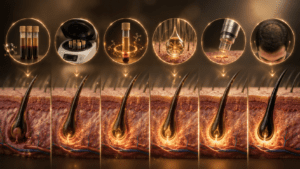
Hair grows in cycles.
Every hair follicle goes through a growth phase, a transition phase, and a resting phase , Under normal circumstances, it is completely normal to lose around 50 to 100 hairs per day.
- The body naturally replaces them with new hair.
- The problem begins when the rate of hair loss becomes greater than the rate of new hair growth.
When this imbalance continues for months, hair density gradually decreases.
- The hair strands become thinner.
- The scalp starts becoming more visible.
Over time, some follicles may shrink and produce finer, weaker hair.
This process is known as follicular miniaturization, and it is one of the most common reasons behind pattern hair loss in both men and women , The earlier this process is identified, the better the chances of preserving existing hair.
Why Waiting Can Make Things Worse
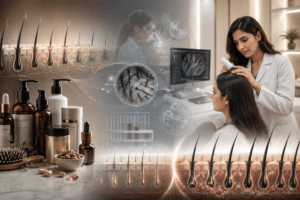
One of the most common statements patients tell us is:
“I thought it would stop on its own.”
Unfortunately, many forms of hair loss become progressively worse if left untreated , Hair follicles are living structures. When they remain weak for a prolonged period, some may stop producing healthy hair altogether , This is why early intervention matters. Seeking professional guidance at the first signs of excessive hair fall often leads to better outcomes than waiting until significant thinning has already occurred.
Think of it this way.
- If a plant begins to wilt, you don’t wait until it completely dries out before giving it water , Hair follicles deserve the same attention.
There Is No Single Magic Solution
Social media has created the illusion that one product can solve every hair problem.
The reality is very different.
- Hair growth is influenced by biology, genetics, hormones, nutrition, and lifestyle.
- No shampoo can permanently reverse genetic hair loss.
- No oil can correct a significant nutritional deficiency.
- No viral remedy can replace proper diagnosis.
Scientific treatment starts with understanding the root cause , Only then can an effective plan be created.
- For some people, improving nutrition may be enough.
- Others may require medical treatment.
- Some may benefit from regenerative procedures such as GFC, PRP, or other advanced therapies.
The right solution always depends on the individual.
The Emotional Side of Hair Loss
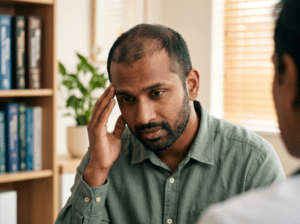
As doctors, we often see something that doesn’t appear in medical textbooks.
The emotional impact:
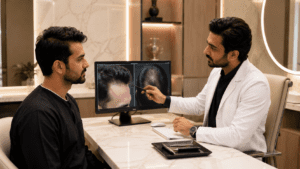
Many patients don’t come to the clinic because of hair alone .They come because they no longer feel like themselves.
- A young professional worried about appearing older than their age.
- A woman who notices her hair becoming thinner after pregnancy.
- A man who avoids social gatherings because he feels self-conscious.
- A bride preparing for her wedding.
- A father who wants to look confident again.
Behind every case of hair loss is a person with feelings, fears, and hopes.
And that is why treatment should never focus only on hair , It should focus on the individual.
What Gives Us Hope
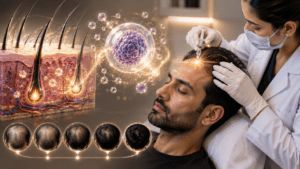
Today, we understand hair biology far better than ever before.
Modern diagnostic tools help identify causes more accurately , Regenerative treatments are helping improve hair quality and density in suitable candidates & Most importantly, awareness has increased. They are making informed decisions instead of relying solely on myths and misinformation.
While not every type of hair loss can be completely reversed, many patients can achieve meaningful improvement when treatment is started at the right time and tailored to their specific condition.
A Final Thought
Hair is more than just appearance.
It is often connected to identity, confidence, and self-expression , Losing hair can feel frustrating, emotional, and sometimes overwhelming But it is important to remember that hair fall is not something you simply have to accept without understanding.
Your hair is trying to tell you something , The question is whether you are listening?
Instead of chasing quick fixes, focus on finding the real cause because when you understand the reason behind the problem, you move one step closer to a solution and sometimes, the first step toward healthier hair is not a treatment.
It is understanding what your hair has been trying to tell you all along.