
One of the most common questions we hear from patients experiencing hair loss is “Doctor, am I too late?”

They usually ask this while looking at an old photograph.
- A photograph from five or ten years ago.
- A photograph with a fuller hairline.
- Thicker density.
More volume & often, a little regret.
- Many wish they had started treatment earlier.
- Many wonder whether PRP or GFC Hair Treatment can still help.
- Many fear hearing the answer.
The truth is that timing matters in hair restoration but “too late” is not always as straightforward as people think to understand when PRP or GFC can help—and when they may not—we first need to understand how hair loss actually happens.
Hair Loss Is Usually A Gradual Process

Most forms of hair loss do not happen overnight hair follicles generally weaken over time.
At first, the changes are subtle.
- The hairline may look slightly different.
- The partition may appear wider.
- The ponytail may feel thinner.
- Hair shedding may increase.
Then slowly, year after year, hair density continues to decrease during this stage, many follicles are still alive they are simply becoming weaker and this is exactly where treatments such as PRP and GFC are often most effective.
PRP and GFC Do Not Create New Hair Follicles
This is perhaps the most important concept for patients to understand.
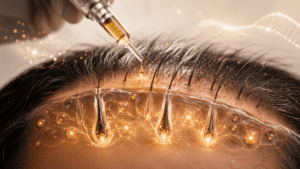
PRP and GFC do not create brand-new hair follicles they work by supporting existing follicles think of a weak plant if the roots are alive, water, sunlight, and nutrients may help it recover but if the roots are completely dead, no amount of care can bring that exact plant back hair follicles behave similarly.
PRP and GFC are designed to support follicles that are still living but struggling the treatments aim to improve the environment around those follicles and encourage healthier growth cycles.
- The key word is existing.
- The follicle must still be there.
The Best Candidates Usually Still Have Hair
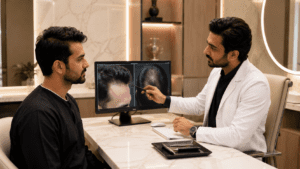
Many patients assume treatment should begin only after significant hair loss develops , Ironically, the opposite is often true.
The best candidates for PRP or GFC are usually people who still have hair.
They may notice:
- Increased hair fall.
- Reduced density.
- Hair thinning.
- A widening partition.
- A receding hairline.
- Miniaturized hair strands.
- Visible scalp in bright light.
- The follicles are present.
They are simply becoming weaker this stage often offers the greatest opportunity for improvement.
When Hair Follicles Become Permanently Inactive
As hair loss progresses, some follicles eventually stop producing visible hair altogether over time, these follicles may become dormant for prolonged periods.
In advanced stages, some areas of the scalp may appear completely smooth and shiny this appearance often suggests that many follicles are no longer functioning at this point, regenerative treatments generally have fewer follicles available to stimulate.
- The challenge is no longer improving weak follicles.
- The challenge is that there may be very few active follicles remaining.
This is when treatment outcomes become more limited.
The “Shiny Scalp” Sign
A useful concept patients often understand easily is the difference between thinning and baldness.
Thinning means hair is still present.
- Even if it is weak.
- Even if it is sparse.
Baldness often means the follicles have been inactive for a long time.
A shiny scalp with no visible hair shafts usually provides fewer opportunities for PRP or GFC to produce meaningful improvement this does not mean treatment is impossible but expectations need to be realistic the earlier treatment begins, the more follicles there are to preserve.
Why Younger Patients Often Respond Better

Age itself is not the deciding factor follicle health is however, younger patients often seek help earlier.
- Their follicles may still be actively miniaturizing rather than completely inactive.
- This gives regenerative treatments a larger target to work with.
- That said, many patients in their forties, fifties, and even beyond can still benefit if viable follicles remain.
- The calendar matters less than the condition of the scalp.
Hair Fall and Hair Loss Are Not the Same Thing
Many people use these terms interchangeably but they are different.
- Hair fall refers to shedding.
- Hair loss refers to reduced density over time.
A patient may be shedding heavily but still have a large number of recoverable follicles another patient may have minimal shedding but significant long-term follicle loss this is why proper scalp assessment is so important.
The amount of hair on the pillow does not always reveal what is happening beneath the surface.
The Biggest Mistake Patients Make
The biggest mistake is waiting.
Not because PRP or GFC suddenly stop working after a certain birthday but because hair loss is progressive every year that passes may mean fewer healthy follicles remain many patients spend years trying:
- Different oils.
- Different shampoos.
- Home remedies.
- Internet advice.
By the time they seek professional help, the window of opportunity may be smaller than it once was hair restoration is often easier when we are preserving hair rather than trying to recover hair that has already been lost.
Does This Mean Hair Transplant Is The Only Option Later?
Not necessarily.
Many patients benefit from a combination approach hair transplantation may restore density in areas where follicles are no longer viable meanwhile, PRP, GFC, or other supportive treatments may help maintain existing hair around transplanted areas these treatments are not competitors they often work together as part of a long-term hair restoration strategy.
The best plan depends on the individual scalp, pattern of hair loss, and treatment goals.
A Final Thought
If you’re wondering whether it is too late for PRP or GFC Hair Treatment, remember this:
- The question is not your age.
- The question is whether your hair follicles are still alive.
PRP and GFC work best when they have living follicles to support the earlier treatment begins, the greater the opportunity to preserve and strengthen existing hair that is why the most important step is not guessing it is getting your scalp properly evaluated because sometimes patients think they are too late when they are not.