
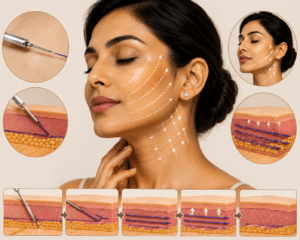
Facial ageing does not happen in the same way for everyone.
Some people first notice that their jawline is becoming less defined. Others begin seeing early jowls, mild cheek descent, a heavier lower face, sagging around the eyebrows or looseness developing around the neck.
At Brilliance Cosmocare, DN Nagar, Andheri West, Mumbai, one of the most common questions we hear is:
“Why should I consider a Thread Lift instead of simply waiting until I need a facelift?”
After more than 10 years of experience in aesthetic treatments, our approach is that Thread Lift Treatment is not about trying to replace surgery for everyone.
Its value is mainly in the right patient—someone with early to moderate tissue laxity who wants a more subtle, minimally invasive lifting option.
The American Society of Plastic Surgeons describes thread lifting as a minimally invasive procedure that can mechanically reposition tissue and is commonly considered for early facial loosening, jowls, sagging eyebrows and early neck laxity.
The real question is therefore not: “Is Thread Lift important for everyone?”
It is: “Is Thread Lift appropriate for the type and degree of facial sagging I actually have?”
Why Is Thread Lift Treatment Important in Facial Rejuvenation?
One of the biggest changes that happens with facial ageing is not simply the development of wrinkles.
- The position of facial tissues changes.
- Cheeks may begin to descend.
- The jawline may become less defined.
- Jowls can start appearing.
- The lower face can look heavier.
- The eyebrow area may begin to sit lower.
- The neck may gradually lose some of its previous firmness.
A Thread Lift is relevant because it approaches facial ageing from the perspective of support and repositioning, rather than treating every ageing concern as a wrinkle.
This is important.
A wrinkle treatment and a lifting treatment
are not necessarily solving the sa
me problem.
If the main concern is that facial tissue has started to descend, simply treating the skin surface may not create the kind of structural improvement the patient wants.
The American Society of Plastic Surgeons specifically identifies early loosening of facial structures, jowls, sagging eyebrows and premature loosening of neck skin among the concerns for which thread lifting may be considered.
Why Do Some Patients Prefer Thread Lift Over Surgery?
Not every patient who notices facial sagging is ready for or requires a surgical facelift.
Some patients are in an earlier stage of ageing.
They may feel: “My face has started to look slightly lower or heavier, but I am not ready for surgery.”
This is the space where Thread Lift Treatment can become relevant.
It offers a minimally invasive option for s
elected patients seeking a relatively subtle lifting effect rather than the degree of correction associated with surgical facelift procedures.
However, this does not mean Thread Lift should be described as a “non-surgical facelift” capable of giving identical results.
Published reviews have repeatedly pointed out that the evidence for thread lifting is more limited than for established surgical rejuvenation, and it should not be presented as a direct replacement for facelift surgery in patients with substantial laxity.
That distinction is central to appropriate patient selection.

Who May Be a Good Candidate for Thread Lift Treatment?
Thread Lift Treatment is generally more relevant for people experiencing early or moderate facial laxity rather than severe sagging.
The American Society of Plastic Surgeons notes that both men and women seeking improvement in early jowls, wrinkles and sagging skin may be considered after assessment of their anatomy and treatment goals.
Published clinical research has also reported favourable outcomes in appropriately selected patients with modest facial sagging.
Someone may therefore consider Thread Lift when they notice:
- Early jowls
- Reduced jawline definition
- Mild cheek descent
- Lower-face heaviness
- Sagging around the eyebrow area
- Early neck laxity
- General mild facial tissue descent
But having one of these concerns does not automatically mean threads are the correct treatment.
The severity matters.
Why Is Thread Lift Often More Appropriate Before Sagging Becomes Severe?
This is one of the most important points we explain at Brilliance Cosmocare.
Thread lifting has limits.
Research examining facial rejuvenation with threads has suggested that patients with mild tissue descent and adequate skin elasticity tend to be better candidates, whereas moderate-to-severe laxity can produce less satisfactory results because excess skin may remain even after repositioning.
This means waiting until there is significant loose skin and then expecting a few threads to recreate the result of surgery may lead to unrealistic expectations.
Thread lifting is generally better understood as a limited lifting option for selected degrees of laxity, not as a solution for every stage of facial ageing.
Why Consider Thread Lift for the Cheeks?
The cheeks are one of the areas where early facial ageing becomes particularly noticeable.
Over time, patients may feel that the mid-face appears flatter, heavier or lower.
Some patients describe it as:
“My cheeks used to sit higher.”
In selected patients, thread lifting may be considered when the objective is to provide subtle repositioning of descended tissue rather than adding large amounts of volume.
This distinction matters because not every patient with a tired-looking mid-face actually needs filler.
If the primary problem is loss of volume, filler may have a role.
If the dominant issue is tissue descent, a lifting strategy may be more relevant.
And in some patients, neither treatment alone may adequately address the full concern.
That is why facial assessment matters more than selecting a treatment based purely on one photograph.
Why Consider Thread Lift for the Jawline?
A defined jawline is one of the features patients frequently want to preserve as they age.
When tissue begins moving downward, the clean transition between the lower face and neck can become less visible.
The patient may start saying:
“My jawline is disappearing.”
This does not necessarily mean the jawbone itself has changed dramatically.
Soft-tissue descent can contribute to the appearance.
Thread lifting may therefore be considered in selected patients where early tissue laxity is contributing to reduced lower-face definition. The facial anatomy and direction of tissue descent need to be evaluated carefully because thread placement is anatomically dependent.
The goal should be improvement not an artificial razor-sharp jawline that does not suit the patient’s anatomy.
Why Consider Thread Lift for Jowls?
Jowls are one of the classic concerns associated with early lower-face ageing.
They develop when tissue begins descending around the jawline, creating heaviness on either side of the chin.
The American Society of Plastic Surgeons specifically lists jowls as a concern that may be addressed with thread lifting.
For someone with early jowling, Thread Lift may therefore be considered as part of a facial-contouring plan.
However, significant jowls accompanied by substantial loose skin require a different conversation.
The greater the degree of laxity, the less reasonable it becomes to expect a minimally invasive treatment to reproduce a surgical result.

Why Consider Thread Lift for the Lower Face?
Sometimes patients cannot point to one specific concern.
They simply say:
“My lower face looks heavier than it used to.”
This can involve several overlapping changes:
- Early jowling
- Softening of the jawline
- Tissue descent
- Changes around the mouth
- Increasing heaviness toward the chin
Thread lifting may be considered when the dominant concern is mild downward movement of tissue.
This is different from treating pigmentation, fine surface lines or isolated facial volume loss.
From our clinic perspective, correctly identifying the dominant problem is crucial.
Not every lower-face concern should automatically be treated with threads.
Why Consider Thread Lift for Sagging Eyebrows?
A lower eyebrow position can create a heavier appearance around the upper face.
Some patients notice that the outer eyebrow appears lower or that the eye area looks more tired.
The American Society of Plastic Surgeons includes sagging eyebrows among the concerns that thread lifting can potentially address.
In appropriately selected patients, threads may therefore be considered for a subtle brow-position change.
But this should not be confused with a surgical brow lift.
The objective is usually modest repositioning rather than dramatic alteration of eyebrow shape.
This is especially important because even small changes around the eyebrows can significantly influence facial expression.
Why Consider Thread Lift for Neck Laxity?
The neck often begins showing signs of ageing at a different pace from the face.
Some people maintain relatively good facial skin while noticing:
“My neck has started becoming loose.”
The American Society of Plastic Surgeons identifies premature loosening of neck skin as another concern that may be considered for thread lifting.
However, neck ageing can involve several different issues:
- Skin laxity
- Excess fat
- Muscle banding
- Structural changes
- Significant excess skin
Threads are not designed to correct all of these problems equally.
A patient with mild laxity has a very different treatment requirement from someone with substantial excess neck skin.
That is why neck assessment should determine whether threads genuinely have a role.
Why Facial Anatomy Matters
One of the reasons Thread Lift Treatment cannot be standardised for every patient is facial anatomy.
Different facial areas contain nerves, vessels, glands, retaining ligaments and tissue planes that need to be understood when planning treatment.
A 2024 anatomical review emphasised that safe and effective thread lifting requires detailed knowledge of facial anatomy because tissues need to be repositioned while avoiding important underlying structures.
This is why two people asking for a “jawline thread lift” may receive different treatment plans
Their faces are not anatomically identical.

Why Thread Lift Is Not for Everyone
A good Thread Lift consultation should sometimes end with:
“Threads are not the best option for you.”
That may be the correct answer if the patient has:
- Significant excess skin
- Severe facial sagging
- Expectations similar to surgical facelift results
- A facial concern primarily caused by volume loss rather than laxity
- Anatomy that does not suit the proposed treatment
Published literature supports being conservative with patient selection because thread lifting has recognised limitations, and stronger evidence for long-term effectiveness remains limited.
This does not make Thread Lift ineffective.
It means the treatment needs to be used for the right problem.
Why Our Approach at Brilliance Cosmocare Starts With the Concern, Not the Thread
After more than 10 years of experience in aesthetic treatments, our approach at Brilliance Cosmocare is not:
“You have ageing, therefore you need threads.”
We first identify:
Which area is changing?
- Is it the cheeks?
- Jawline?
- Jowls?
- Lower face?
- Eyebrows?
- Neck?
Then we evaluate the degree of laxity and the type of correction the patient actually wants.
Only after that does it make sense to discuss whether Thread Lift Treatment has a useful role.
Because facial ageing is three-dimensional.
- Sometimes the concern is tissue descent.
- Sometimes it is volume loss.
- Sometimes it is skin quality.
And sometimes several of these problems exist together.
Final Thoughts
The real reason to consider Thread Lift Treatment is not because it is trending or because it is marketed as a quick alternative to surgery.
Its value is that it can provide a minimally invasive lifting option for appropriately selected patients with early or moderate facial tissue laxity.
At Brilliance Cosmocare, DN Nagar, Andheri West, Mumbai, we may consider Thread Lift Treatment for concerns involving the:
- Cheeks
- Jawline
- Jowls
- Lower face
- Eyebrow area
- Neck
But each of those areas requires different thinking.
A mildly sagging cheek is not the same problem as a heavy jowl.
An early soft jawline is not the same as significant loose neck skin.
And a patient with substantial facial sagging should not be given unrealistic expectations from a minimally invasive procedure.
Our philosophy after more than 10 years in aesthetic care is therefore straightforward:
Do not choose Thread Lift simply because you want a “lift.” First identify what is actually sagging, how much correction is realistically possible and whether threads are the appropriate treatment for that particular facial area.
That is where responsible Thread Lift treatment begins.