
There is a particular kind of conversation that happens in skin consultations with some regularity. A patient comes in with a concern that has clearly worsened over a specific period – acne that has become more severe and more cystic, hair that has started coming out in alarming quantities, or skin that has suddenly become dull and reactive after years of being relatively settled. The standard questions are asked: any change in diet? New skincare products? New medications?
And then – almost always – the timeline becomes clear. The acne worsened around the time of a major work deadline. The hair started falling out three months after a period of sustained professional crisis. The skin became reactive during the months of a complicated personal situation.
Every time this pattern appears in a consultation, it is a reminder of something that medicine has known for decades but that most patients have not yet fully internalised: stress is not just a psychological experience. It is a physiological one, with direct, measurable consequences for the skin, the hair, and the overall appearance – consequences that are not imagined, not exaggerated, and not coincidental.
For adults living and working in Mumbai – a city with a unique combination of professional intensity, physical commuting stress, environmental load, social pressure, and the particular ambition-driven pace of one of the world’s most demanding urban environments – this connection between stress and skin is not academic. It is a daily clinical reality.
This blog explains exactly what stress does to the skin and hair at the biological level, why the effects are so visible, why Mumbai’s environment amplifies them, and what can be done about it – both through lifestyle management and through clinical treatment.
The Biology of Stress – What Actually Happens in the Body
To understand how stress affects the skin and hair, you first need to understand what stress actually does in the body – because the mechanism is not vague or metaphorical. It is specific, hormonal, and well-characterised.
When the brain perceives a threat – physical, psychological, social, or professional – it activates the hypothalamic-pituitary-adrenal (HPA) axis. The hypothalamus signals the pituitary gland, which signals the adrenal glands (sitting above the kidneys) to release cortisol – the body’s primary stress hormone. Simultaneously, the sympathetic nervous system triggers the release of adrenaline (epinephrine) and noradrenaline – the “fight or flight” hormones responsible for the immediate physiological stress response.
This system evolved as a survival mechanism. In the short term, it is genuinely useful – cortisol mobilises energy reserves, sharpens focus, and prepares the body to respond to an immediate threat. The problem is that this system was designed for acute, time-limited stressors – the threat appears, the stress response is activated, the threat passes, the response resolves. It was not designed for the sustained, chronic, low-to-moderate level stress that characterises modern professional life in a city like Mumbai – the kind where the “threat” is a continuous state of professional pressure, financial concern, relationship complexity, and environmental load that never fully resolves and allows the HPA axis to return to baseline.
When cortisol is chronically elevated – present at higher-than-baseline levels day after day, month after month – its effects on the skin, hair, and body are significant and cumulative.
How Stress Affects the Skin – The Specific Mechanisms
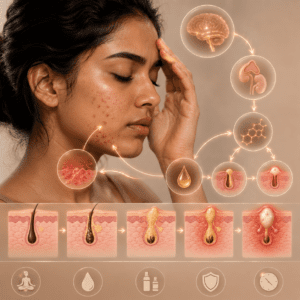
Stress and Acne – The Cortisol-Androgen Connection
The relationship between stress and acne is one of the most clinically documented stress-skin connections – and one of the most commonly observed at Brilliance Cosmocare among Mumbai’s professional patient population.
Cortisol stimulates the adrenal glands to produce androgens – particularly DHEA-S (dehydroepiandrosterone sulfate). These androgens act on sebaceous glands, stimulating them to produce more sebum – the oily substance that, when combined with dead skin cells and bacteria, forms the foundation of acne. Cortisol also increases levels of a neuropeptide called substance P in the skin – which directly triggers sebaceous gland activity and inflammatory responses in the follicle.
The result: chronically elevated cortisol produces chronically elevated androgen-driven sebum production, which means more clogged pores, more bacterial activity, and more inflammatory acne lesions – particularly the deeper, more painful cystic and nodular acne that is characteristic of hormonally driven breakouts.
This is why the “stress breakout” pattern is so recognisable and so consistent. It is not psychosomatic. It is hormonal. The acne that appears reliably before a major deadline, during an extended difficult work period, or through a sustained personal crisis is expressing a documented biological pathway – not an imagined connection between emotion and skin.
For Mumbai patients dealing with persistent or cyclical acne that worsens predictably during high-stress periods, addressing the cortisol pathway – through stress management, sleep improvement, and where appropriate clinical support – is as important as the topical and procedural treatment of the acne itself.
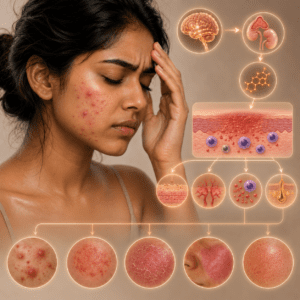
Stress and Skin Inflammation – Worsening Existing Skin Conditions
The skin has its own immune system – a network of skin-resident immune cells (particularly mast cells and Langerhans cells) that maintain a constant low-level surveillance of the skin’s environment. Cortisol and other stress hormones interact with this local immune system in complex ways – and the net effect in chronic stress is an increase in pro-inflammatory signalling in the skin.
This has several consequences:
- Inflammatory skin conditions worsen under chronic stress. Eczema (atopic dermatitis), psoriasis, rosacea, perioral dermatitis, and seborrheic dermatitis – all of which have immune-mediated inflammatory components – characteristically flare during sustained periods of stress. This is not coincidence. Cortisol modulates the skin’s immune response in ways that shift the balance toward the inflammatory pathways that drive these conditions.
- The skin’s barrier function weakens under chronic stress. The skin barrier – the outermost layer of the epidermis – maintains the skin’s hydration and excludes irritants and allergens. Cortisol directly reduces the production of the lipids and proteins that maintain this barrier, making chronically stressed skin more permeable, more reactive, more prone to sensitivity, and more susceptible to irritant and allergic reactions.
- Wound healing slows. One of the specific effects of chronic cortisol elevation is suppression of the inflammatory response that is paradoxically necessary for normal wound healing. Post-acne marks take longer to heal. Cuts and small skin injuries take longer to resolve. The skin’s recovery from any kind of insult – including clinical treatments – is slower and less efficient.
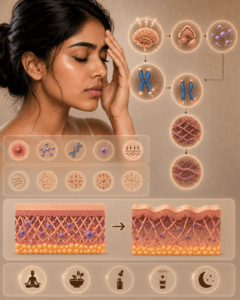
Stress and Skin Ageing – The Telomere and Collagen Story
The relationship between chronic stress and accelerated skin ageing is one of the most extensively studied stress-biology connections – and it operates through several distinct mechanisms.
- Telomere shortening: Telomeres are the protective caps at the ends of chromosomes – essentially a biological clock that shortens with each cell division. When telomeres become critically short, cells can no longer divide normally and enter a state called cellular senescence. Chronic psychological stress – particularly severe, sustained stress – is associated with accelerated telomere shortening, which has been documented in multiple studies comparing high-stress populations to low-stress controls. Shorter telomeres in skin cells means faster skin ageing at the cellular level.
- Oxidative stress: Cortisol and the stress response generate reactive oxygen species (ROS) – free radical molecules that damage cellular structures including collagen, DNA, and lipid membranes. The antioxidant systems that normally neutralise these free radicals are overwhelmed during periods of sustained stress – producing cumulative oxidative damage to skin cells that accelerates the visible ageing process.
- Collagen degradation: Cortisol directly activates enzymes called matrix metalloproteinases (MMPs) – which break down collagen in the dermis. Simultaneously, cortisol suppresses fibroblast activity and reduces the production of new collagen. The combined effect is a net reduction in dermal collagen – the structural protein responsible for skin firmness, elasticity, and youthful resilience. The accelerated skin laxity, fine lines, and loss of firmness that many Mumbai professionals notice during sustained high-stress periods reflects this cortisol-collagen pathway.
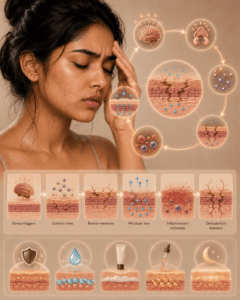
Stress and Skin Dehydration – The Barrier Breakdown Cycle
As mentioned above, chronic stress weakens the skin’s barrier function. The specific consequence of this barrier breakdown – beyond increased reactivity – is transepidermal water loss (TEWL): the continuous evaporation of water from the skin surface that the barrier normally prevents.
When the barrier is compromised by chronic cortisol elevation, TEWL increases – the skin becomes chronically dehydrated even in patients who drink adequate water and use appropriate moisturisers. The dehydrated appearance that many Mumbai professionals notice during high-stress periods – the flat, dull, lifeless quality that no amount of skincare seems to fully address – is partly a physical consequence of the barrier breakdown that stress produces.
This dehydration also creates a vicious cycle: dehydrated, barrier-compromised skin is more reactive and more prone to inflammation – which increases cortisol and stress responses through the skin-brain axis – which further elevates cortisol – which further compromises the barrier. This cycle explains why stressed skin seems to spiral downward rather than stabilise – each negative effect reinforces the next.
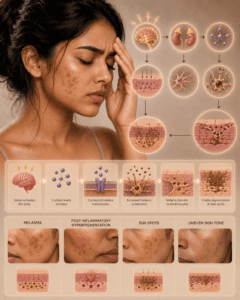
Stress and Pigmentation – The Cortisol-Melanin Connection
Cortisol and the stress-related neuropeptides produced during the stress response – particularly ACTH (adrenocorticotropic hormone) and MSH (melanocyte-stimulating hormone) – directly stimulate melanocytes to produce more melanin. For patients who are already prone to hyperpigmentation – particularly Indian patients with Fitzpatrick III–V skin types where melanocytes are highly reactive – sustained stress can drive or worsen pigmentation in ways that are distinct from the UV-driven pathway.
This is why melasma frequently worsens during sustained periods of psychological stress – even in patients who are diligent about sun protection. It is also why post-acne marks are more pronounced and slower to heal during high-stress periods – the combination of stress-driven acne and stress-driven melanocyte hyperactivity creates a particularly difficult pigmentation environment.
For Mumbai patients undergoing pigmentation treatment – chemical peels, laser, Glutathione IV – unmanaged chronic stress can meaningfully undermine treatment outcomes by continuously stimulating the very melanocyte activity that the treatments are working to suppress.
How Stress Affects the Hair – The Hair Loss Connection
If skin is the most immediately visible domain of stress’s aesthetic effects, hair is the most emotionally impactful. Hair loss – whether gradual or sudden – carries a disproportionate psychological burden precisely because it is one of the most visible and socially salient aspects of appearance, and because cultural associations with hair and vitality are deeply embedded.
There are two primary patterns of stress-related hair loss, and they operate through completely different mechanisms.
Telogen Effluvium – The Shed That Follows the Storm
Telogen effluvium is the most common form of stress-related hair loss – and it has a timing pattern that makes it particularly confusing and distressing for patients who experience it.
Hair grows in cycles: anagen (active growth, lasting 2–7 years), catagen (transitional, lasting 2–3 weeks), and telogen (resting, lasting 2–3 months). At any given time, approximately 85–90% of scalp hairs are in the anagen phase and 10–15% are in telogen. At the end of the telogen phase, the hair sheds naturally.
When the body experiences a significant stress – physiological (illness, surgery, dramatic weight loss, nutritional deficiency) or psychological (severe sustained psychological stress, major life disruption) – it can signal a large number of anagen-phase hairs to simultaneously shift into telogen. This is a biological triage mechanism – under perceived threat, the body redirects energy away from non-essential functions like hair growth.
The shift into telogen is not immediately visible. The hair that has shifted into telogen sits in the follicle for the standard 2–3 month telogen duration before shedding. This means that the hair loss that patients experience – often dramatic, diffuse shedding that fills hairbrushes, appears in the shower drain, and covers pillowcases – occurs 2–3 months after the triggering stress event, not during it.
This delay is exactly why telogen effluvium is so confusing. The patient who experienced a major work crisis in January notices dramatic hair loss in March or April – and connects it to whatever is happening in April rather than to the January event. The actual cause is temporally displaced from the visible consequence.
The good news about telogen effluvium is that it is typically self-limiting – once the triggering stress resolves, the follicles return to anagen and hair regrowth occurs over 6–12 months. The challenging news is that during a period of sustained, unresolved chronic stress – which describes many Mumbai professionals – the triggering event never fully resolves, and the telogen effluvium can become persistent rather than self-limiting.
Alopecia Areata – The Autoimmune Hair Loss of Stress
Alopecia areata is a distinct form of hair loss – an autoimmune condition in which the immune system attacks hair follicles, producing rapid, patchy hair loss that can be dramatically sudden in onset. A patient can have a full head of hair and then develop a 5cm patch of complete baldness within days.
The relationship between stress and alopecia areata is well-documented – psychological stress is one of the most consistently identified triggers for both initial onset and relapse of the condition. The mechanism involves stress-driven immune dysregulation – the cortisol-influenced alterations in immune cell behaviour that, in susceptible individuals, can trigger the autoimmune attack on follicles.
Alopecia areata is significantly more distressing than telogen effluvium because of its sudden onset, the complete loss of hair in affected patches, and its less predictable natural history. Some patches recover spontaneously; others progress to more extensive or complete scalp hair loss. Treatment requires clinical assessment and management – including intralesional corticosteroid injections, topical treatments, and in some cases systemic therapy – with stress management as a critical concurrent element.
The Overall Appearance Consequences – Beyond Skin and Hair
Stress’s aesthetic effects extend beyond the skin and scalp – producing broader appearance changes that are visible and meaningful but often not connected to their cause.
Dark Circles and Under-Eye Puffiness
Dark circles under the eyes have multiple causes – genetic pigmentation, blood vessel visibility through thin under-eye skin, and shadow from volume loss are the most common. But stress adds a specific contributing mechanism: cortisol-driven fluid retention and impaired lymphatic drainage, combined with sleep deprivation (itself a consequence of stress), produce the puffiness and darkness that is colloquially described as “looking exhausted.”
Poor sleep – which chronic stress reliably produces through cortisol’s interference with the circadian rhythm and melatonin production – is written most clearly on the face in the under-eye area. The puffy, dark, hollowed under-eye appearance that characterises sleep deprivation and chronic stress is one of the most universally recognised markers of someone who is not well.
Dull, Grey Complexion
The combination of impaired microcirculation (cortisol constricts blood vessels, reducing skin blood flow and therefore the natural flush of oxygenated blood that gives skin its colour), accumulated free radical damage, impaired cell turnover, and reduced barrier hydration produces the characteristic dull, grey, flat complexion of chronic stress. This is the skin that looks like it needs a holiday – because physiologically, it does.
Weight Changes and Body Composition
Cortisol drives appetite – specifically appetite for high-calorie, high-sugar, high-fat foods – through its effects on hunger hormones and the brain’s reward circuitry. It also promotes visceral fat storage – particularly abdominal fat deposition, which is the health-damaging fat pattern most prevalent in South Asian individuals and most resistant to lifestyle intervention without addressing the cortisol component.
Chronic stress is one of the primary drivers of the abdominal weight gain that many Mumbai professionals notice during and after particularly demanding professional periods – and which resists conventional diet and exercise approaches because the hormonal environment driving it has not been addressed.
The Mumbai Amplifier – Why Urban Professional Stress Hits the Skin Harder
Mumbai’s urban environment amplifies the stress-skin connection through several distinct mechanisms that compound the cortisol-driven effects described above.
- Air pollution: Fine particulate matter and environmental toxins generate oxidative stress in skin cells – adding a direct biochemical burden on top of the cortisol-driven oxidative stress. Mumbai’s pollution load means that the skin’s antioxidant reserves are depleted more rapidly than in cleaner environments – and the combined demand of cortisol-generated ROS and pollution-generated ROS on a single skin’s antioxidant system is significant.
- Heat and humidity: The physical stress of Mumbai’s climate – particularly in the pre-monsoon summer months – is a genuine physiological stressor. Extreme heat activates the HPA axis and drives cortisol release independently of psychological stress. Combined with psychological stress, the cortisol load on the skin is amplified beyond what either stressor would produce alone.
- Sleep deprivation: Mumbai’s commuting culture, late professional hours, and the challenge of winding down in a city that does not quieten easily mean that sleep deprivation is endemic. Sleep deprivation itself is a potent stressor – elevating cortisol, impairs skin repair (which occurs primarily during deep sleep through growth hormone release), reduces immune function, and accelerates every skin ageing mechanism described above.
- Nutritional quality: The food environment for many Mumbai professionals – time-pressured, convenience-oriented, rich in refined carbohydrates and low in the micronutrients that support skin and hair health – creates nutritional deficiencies that compound the stress-driven skin consequences. Iron deficiency – extremely common among Mumbai women and a significant driver of hair loss – is worsened by stress through multiple pathways.
What You Can Do – The Clinical and Lifestyle Response
Understanding that stress is driving skin and hair consequences is useful only if it translates into actionable responses. The approach needs to operate on two levels simultaneously: managing the stress and its hormonal effects, and providing clinical support for the skin and hair that is already bearing the consequences.
Lifestyle Interventions That Actually Matter for Skin and Hair
- Sleep quality above quantity: Seven to eight hours of high-quality sleep has more significant skin and hair benefits than eight hours of fragmented, poorly structured sleep. Cortisol follows a circadian pattern – it should be lowest in the first hours of sleep and rise to its peak in the early morning. Stress disrupts this rhythm, maintaining elevated cortisol through the night and preventing the growth hormone release that drives skin repair. Practices that improve sleep quality – including consistent sleep and wake times, reduced blue light exposure in the evening, and management of the pre-sleep cortisol peak – produce visible skin and hair benefits.
- Physical activity – the right kind: Moderate, regular aerobic exercise reduces chronic cortisol levels and upregulates the skin’s antioxidant defences – producing genuine skin health benefits. However, excessive high-intensity exercise – particularly chronic overtraining – can actually raise cortisol and worsen stress-related skin consequences. The sweet spot for skin and hair benefit is regular moderate exercise: walking, swimming, cycling, yoga, or moderate gym work.
- Dietary anti-inflammatory support: A diet rich in omega-3 fatty acids (fatty fish, flaxseed, walnuts), antioxidants (colourful vegetables and fruits), zinc (pumpkin seeds, legumes, nuts), and adequate protein supports skin barrier function, reduces inflammatory signalling, and provides the building blocks for hair growth. The anti-inflammatory dietary pattern – high in whole foods, low in refined carbohydrates and ultra-processed foods – directly counteracts several of the cortisol-driven skin and hair consequences described above.
- Stress management techniques that have clinical evidence: Mindfulness-based stress reduction, breathing techniques (particularly slow, diaphragmatic breathing that activates the parasympathetic nervous system and directly suppresses the HPA axis response), and progressive muscle relaxation all have documented evidence for reducing cortisol and improving stress-related skin outcomes. These are not alternative therapies – they are physiological interventions that produce measurable hormonal effects.
Clinical Treatments for Stress-Affected Skin and Hair in Mumbai
Lifestyle management addresses the cause; clinical treatment addresses the consequence. For Mumbai patients dealing with stress-related skin and hair damage that has accumulated over months or years, a structured clinical programme at Brilliance Cosmocare addresses the specific manifestations.
- For stress-related acne: Medical-grade salicylic acid peels and LED blue light therapy target the hormonal sebum excess and bacterial load that stress-driven cortisol and androgens produce. Where hormonal acne is significant and persistent, prescription topical and oral management addresses the androgen pathway directly.
- For stress-related pigmentation: Mandelic acid peels, Glutathione IV Drip therapy, and Q-switched laser – combined with rigorous SPF compliance – address the accumulated melanin burden produced by stress-driven melanocyte activation.
- For stress-related skin ageing: Profhilo for deep hydration and collagen stimulation, HIFU for structural skin tightening, and Anti Wrinkle Injection for stress-exacerbated expression lines – combined with prescribed antioxidant topical skincare (vitamin C, retinoids, niacinamide) – address the collagen loss, dehydration, and dynamic wrinkling that chronic stress accelerates.
- For stress-related hair loss: GFC (Growth Factor Concentrate) therapy is particularly effective for telogen effluvium and early androgenetic alopecia – delivering concentrated growth factors directly to the follicle environment, stimulating dormant follicles to re-enter anagen and reducing the inflammatory signalling that cortisol drives in the scalp. Combined with nutritional assessment and correction of deficiencies (iron, vitamin D, zinc) – extremely common in Mumbai’s stressed, often nutritionally depleted professional population – GFC hair treatment produces meaningful improvement in hair density and hair fall.
- For stress-related overall skin quality: Antioxidant IV therapy – including Glutathione IV Drip – replenishes the antioxidant reserves depleted by chronic stress-generated free radical damage, improving the systemic oxidative environment in which the skin cells are functioning. Regular monthly chemical peels for skin maintenance, prescribed topical antioxidant skincare, and meticulous daily SPF 50 are the clinical maintenance tools for keeping stress-affected skin in its best possible condition.
The Interconnected Cycle – And How to Break It
One of the most clinically important observations about stress and skin is that the relationship is bidirectional. Stress causes skin and hair problems – and skin and hair problems cause stress. The acne that stress produces affects self-image and increases anxiety, which elevates cortisol, which worsens the acne. The hair loss that stress triggers produces distress about appearance, which elevates cortisol, which prolongs the telogen effluvium. The skin that looks dull and aged affects professional confidence, which creates additional stress, which further suppresses the collagen synthesis that would address the ageing appearance.
This bidirectional cycle is genuinely self-reinforcing – and it means that effective intervention on either side of the cycle produces benefits on both sides. Effective stress management improves the skin and hair – and effective clinical treatment of the skin and hair reduces the stress burden that appearance concerns are generating, creating a positive cycle to replace the negative one.
This is not a trivial insight. It is the clinical rationale for treating stress-related skin concerns with genuine seriousness – not as vanity, and not as a secondary concern to the “real” stress management work. For patients whose appearance concerns are contributing meaningfully to their psychological stress load, clinical skin and hair treatment is part of the stress management programme, not separate from it.
Frequently Asked Questions – Stress and Skin in Mumbai
Why does my skin break out every time I have a stressful work period in Mumbai?
This is a direct hormonal effect. Work stress elevates cortisol, which stimulates adrenal androgen production, which drives sebaceous gland activity and excess sebum production. More sebum in the follicle means more material for Cutibacterium acnes bacteria to metabolise, more inflammatory signalling, and more acne lesions. The stress-acne connection is not psychosomatic – it is a documented hormonal pathway. Managing cortisol through stress reduction and clinical acne treatment that addresses the sebum and bacterial pathways simultaneously produces the most effective results.
How long after a stressful period will my hair start falling out in Mumbai?
Telogen effluvium – the stress-related hair shedding where anagen hairs shift to telogen – typically begins 2–3 months after the triggering stress event. So if you experienced a major stressor in January, you would expect the hair loss to become noticeable in March or April. The temporal displacement between cause and effect is one of the most confusing aspects of this condition. GFC hair treatment, combined with nutritional assessment and stress management, supports follicle recovery and re-entry into anagen.
Can stress cause permanent skin damage in Mumbai?
Chronic, sustained stress can produce cumulative skin ageing through collagen degradation, telomere shortening, and oxidative damage – but most of these effects are partially reversible with appropriate clinical treatment and effective stress management. The exceptions are established acne scars and deep structural laxity – which represent physical changes to the skin’s collagen architecture that require specific clinical intervention (laser, microneedling, thread lift) to address, regardless of whether the stress that contributed to them is subsequently managed.
Is there a specific treatment for stress-related dark circles in Mumbai?
Dark circles from stress and sleep deprivation are multifactorial – involving increased vascular visibility from thinning under-eye skin, pigmentation from chronic rubbing and fatigue, and volume loss creating shadowing. Tear trough filler effectively addresses the volume and shadow component; topical vitamin C and retinol gradually improve pigmentation; improved sleep quality reduces the vascular component. At Brilliance Cosmocare, the treatment approach is determined by which component is dominant in each patient.
Will my skin improve naturally if I reduce my stress levels?
Yes – to a meaningful degree. Reducing cortisol through effective stress management, improved sleep, regular exercise, and dietary anti-inflammatory support allows the skin’s natural repair mechanisms to function more effectively. However, the accumulated consequences of months or years of chronic stress – established pigmentation, collagen loss, hair thinning – require clinical support to address fully and in a practical timeframe. The combination of stress management and clinical treatment produces the best outcomes.
How does Mumbai’s pollution make stress worse for skin?
Pollution generates reactive oxygen species (free radicals) that deplete the skin’s antioxidant reserves. Chronic cortisol from stress simultaneously generates additional free radicals and suppresses the body’s antioxidant production. The combined demand on the skin’s antioxidant system from both pollution and stress is significantly greater than either alone – which is why Mumbai patients dealing with both sustained stress and high pollution exposure often have more significant skin oxidative damage than the stress or pollution alone would predict. Antioxidant skincare (vitamin C, niacinamide, Glutathione IV), thorough evening cleansing to remove pollution deposits, and daily SPF are all particularly important for this patient group.
Conclusion: Your Skin Is Telling You Something – And It Deserves to Be Heard
The connection between what is happening in your professional and personal life and what is happening on your skin and scalp is not coincidental, imagined, or the product of overthinking. It is a direct, physiologically documented consequence of hormones that your body produces in response to the demands being placed on it.
For Mumbai professionals navigating genuinely intense stress environments – in a city that does not offer many escapes from its own pace – the skin and hair are often the most visible indicators that the body is carrying more than it should. They deserve to be addressed with clinical seriousness, not dismissed as cosmetic concerns.
Managing stress – through whatever combination of lifestyle practice, professional support, and mindful attention to sleep, nutrition, and recovery works for you – is the most fundamental thing you can do for your skin and hair. Clinical treatment at Brilliance Cosmocare addresses the consequences that have already accumulated and supports the skin and hair through the ongoing demands of Mumbai life.
Both are necessary. Neither is sufficient without the other. And together – they produce visible, meaningful results that reflect, in the most honest way, how you are actually feeling.
Ready to Address Your Stress-Related Skin and Hair Concerns in Mumbai?
Book your consultation at Brilliance Cosmocare, Andheri West, Mumbai and receive a comprehensive skin and hair assessment – with a clinical programme designed to address the specific consequences of stress on your appearance, alongside guidance on the lifestyle and nutritional factors that will support your results.
Serving patients from Andheri, Juhu, Versova, Lokhandwala, Bandra, Santacruz, and across Mumbai.
Brilliance Cosmocare Skin Clinic Andheri West, Mumbai
Call now to book your consultation
Your skin has been absorbing the pressure of your life for months. It is time to give it some of that energy back.