
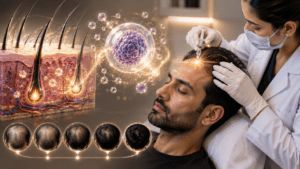
When people start researching treatments for hair thinning, they quickly come across several names: PRP, GFC, mesotherapy, minoxidil, finasteride, low-level laser therapy, exosomes and hair transplantation.
With so many options available, GFC is increasingly discussed as an advanced regenerative treatment for hair loss. But calling any hair treatment “the best” without understanding the patient’s actual condition can be misleading.
So, what exactly is GFC Hair Regrowth Treatment? What makes it different from other hair treatments? And can GFC genuinely be considered the best option for hair regrowth?
At Brilliance Cosmocare in DN Nagar, Andheri West, Mumbai, with more than 10+ years of experience in hair and aesthetic treatments, we believe patients should understand the treatment itself before deciding whether it belongs in their hair-regrowth plan.
What Is GFC Hair Treatment?
GFC stands for Growth Factor Concentrate.
It is an autologous regenerative hair treatment, meaning the material used for treatment is prepared from the patient’s own blood rather than being a synthetic hair-growth substance.
Blood naturally contains platelets, and platelets contain biologically active growth factors. GFC-based techniques are designed to obtain a concentrated preparation of these platelet-derived growth factors for use in areas affected by hair thinning.
Clinical research specifically studying GFC for androgenetic or pattern hair loss has reported encouraging changes in measurements such as hair count and hair-shaft diameter, although GFC research is still considerably smaller than the evidence base behind more established hair-loss treatments.
That last point is important.
GFC should be understood as an emerging regenerative treatment option, not as a miracle injection or guaranteed cure for every form of hair loss.
What Does “Growth Factor Concentrate” Actually Mean?
The phrase may sound complicated, but the concept is relatively straightforward.
Platelets contain signalling proteins commonly referred to as growth factors. These molecules participate in several biological processes involving tissue repair, cell signalling and blood-vessel-related activity.
Platelet-derived preparations have therefore attrac

Research examining concentrated growth factor preparations in androgenetic alopecia suggests that their biological activity may involve several pathways related to the hair follicle and surrounding scalp environment. However, the exact response can vary significantly between patients.
In practical terms, GFC is intended to provide a concentrated platelet-derived growth-factor preparation rather than simply treating the scalp with an external cosmetic product.
What Type of Hair Treatment Is GFC?
GFC falls into the category of regenerative or biologic hair treatments.
That makes it fundamentally different from several other commonly used approaches.
A shampoo primarily works on the hair shaft and scalp surface.
Medication such as minoxidil or finasteride works through pharmacological mechanisms.
A hair transplant physically relocates existing follicles from one part of the scalp to another.
GFC, by comparison, is designed around platelet-derived biological signalling from the patient’s own blood.
This distinction helps explain why comparing GFC directly with every other hair treatment can be misleading.
They are not necessarily doing the same job.
What Is the Difference Between GFC and PRP?
This is one of the most common questions patients ask.
PRP stands for Platelet-Rich Plasma, while GFC stands for Growth Factor Concentrate.
Both are autologous platelet-derived treatments and both begin with the patient’s own blood, but their preparation and final biologic product are not identical.
PRP generally aims to produce plasma containing an increased concentration of platelets. Those platelets subsequently release various growth factors.
GFC techniques are intended to concentrate or obtain the growth-factor component through a more controlled preparation approach.
A 2026 study comparing PRP and GFC in 42 patients with male and female pattern hair loss found improvement with both treatments. GFC showed stronger improvement in certain early measures, including total hair count and shaft diameter, while PRP showed some more sustained advantages at the six-month assessment. The researchers concluded that both can have a role rather than establishing one treatment as universally superior.
That is a far more useful interpretation than simply saying:
“GFC is newer, therefore GFC is better.”
Newer does not automatically mean superior for every patient.
Is GFC Better Than PRP?
For some patients and treatment plans, GFC may be preferred.
For others, PRP may remain a reasonable option.
Current research does not justify claiming that GFC is universally better than PRP for every patient with hair loss.
The 2026 comparative study is promising, but it involved a relatively small number of patients. Larger and longer-term studies are still valuable before strong universal conclusions are made.
The choice should therefore depend on factors such as the diagnosis, stage of thinning, previous treatments, treatment goals, medical history and the doctor’s assessment.
The important comparison is not simply:
GFC vs PRP: Which sounds more advanced?
It is:
Which treatment makes the most sense for this particular scalp and this particular pattern of hair loss?
Is GFC the Best Hair Regrowth Treatment?
There is no scientifically responsible answer that says GFC is the best hair-regrowth treatment for everyone.
Hair loss has multiple causes, and the treatment with the strongest value depends on what is actually causing the hair to thin.
For androgenetic alopecia, established medical treatments continue to play an important role. Reviews of current treatment guidance identify minoxidil and finasteride among the major established pharmacological options, while regenerative and procedural approaches such as PRP and other newer therapies can be considered depending on the patient.
Therefore, GFC should not automatically replace medication simply because it is an injectable regenerative treatment.
Similarly, GFC cannot do the same thing as a hair transplant.
If an area has extensive longstanding follicular loss, a surgical hair transplant may be the more appropriate way to restore hair to that area because transplantation physically moves viable follicular units into the thinning or bald region.
This is why the phrase “best treatment” needs context.
What Makes a Hair Treatment the “Best” Option?
The best hair treatment is the one that matches the diagnosis and objective.
For one patient, that may mean medical treatment.
For another, GFC may be part of the plan.
Another patient may benefit from PRP.
Someone else may require correction of an underlying deficiency or medical problem.
And a patient with advanced permanent hair loss may ultimately require a hair transplant if restoration of a bald area is the objective.
In some cases, the strongest approach may even involve a combination of treatments rather than one treatment alone.
A 2024 systematic review of androgenetic alopecia treatments identified multiple effective oral, topical and procedural approaches, which reinforces an important point: modern hair-loss treatment is not a competition where one treatment wins for every patient.
The treatment should fit the problem.

What Can GFC Be Compared With?
When patients evaluate GFC, they commonly compare it with several alternatives.
- GFC vs PRP
Both use the patient’s own blood and belong to the regenerative-treatment category. Their preparation differs, and emerging research suggests that each may have particular advantages.
- GFC vs Minoxidil
These are fundamentally different treatments.
Minoxidil is a pharmacological treatment with a longer evidence history in pattern hair loss, while GFC is an injectable regenerative approach.
They should not automatically be treated as substitutes for one another.
- GFC vs Finasteride
Again, the mechanisms and treatment objectives differ.
Finasteride targets the androgen pathway involved in male pattern hair loss, whereas GFC is a platelet-derived regenerative treatment.
Which is appropriate requires medical evaluation, and some patients may be considered for combination strategies.
- GFC vs Hair Transplant
This comparison is particularly important.
GFC is intended to work with the patient’s existing follicular environment.
A hair transplant physically relocates hair follicles.
Therefore, GFC should not be presented as an alternative capable of recreating a completely lost hairline or restoring a longstanding smooth bald area in the way transplantation can.
What Is GFC Not?
Understanding what GFC is also means understanding what it is not.
- GFC is not a hair transplant.
- GFC is not a guaranteed cure for genetic baldness.
- GFC is not capable of creating unlimited new follicles.
- GFC is not automatically the correct treatment for every person experiencing hair shedding.
- GFC is not necessarily superior simply because it sounds more advanced than an older treatment.
These distinctions protect patients from unrealistic expectations.
What Should You Understand Before Choosing GFC?
Before deciding whether GFC is the best option, the most important thing to understand is your diagnosis.
“Hair fall” is a symptom, not one single disease.
Pattern hair loss, temporary shedding, nutritional deficiencies, hormonal factors, inflammatory scalp disorders and other forms of alopecia can require very different treatment strategies.
The correct question is therefore not: “Is GFC the best hair treatment?”
It is: “Is GFC the best treatment option for my particular type and stage of hair loss?”
Those two questions sound similar, but medically they are very different.
So, What Is GFC in Simple Terms?
GFC is a doctor-supervised regenerative hair treatment prepared from components of the patient’s own blood, designed to provide concentrated platelet-derived growth factors to areas of thinning hair.
It represents one of several modern options available for hair restoration and hair-loss management.
Research surrounding GFC is encouraging and continues to develop. Recent studies have shown improvements in measurable hair parameters, including comparisons with PRP. But the available evidence does not support calling GFC a universally superior or guaranteed solution for every person experiencing hair loss.
Final Thoughts
After more than 10+ years of experience in hair and aesthetic treatments at Brilliance Cosmocare, our view is that the most important word in hair treatment should not be “best.”
It should be “appropriate.”
GFC can be an important regenerative option for selected patients. PRP can be appropriate in other situations. Medical treatment remains important for many patients with pattern hair loss, while hair transplantation has a different role when follicles need to be physically restored to areas of significant loss.
So when somebody asks:
“Is GFC the best option for hair regrowth?”
The most accurate answer is:
GFC may be one of the better options for the right patient, but no single treatment is the best option for every type, stage or cause of hair loss.
At Brilliance Cosmocare, DN Nagar, Andheri West, Mumbai, the objective is to first understand the hair-loss condition and then determine where GFC fits within a personalised hair-regrowth strategy.
Because choosing the right treatment starts with understanding exactly what the treatment is and what it is not.