
For many people, the word “hair loss” immediately brings one thing to mind: Hair transplant.
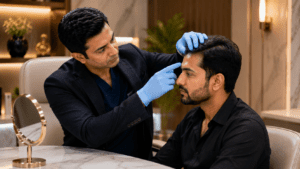
They assume that once hair starts thinning, surgery is the only option left.
- The hairline begins moving back.
- The partition becomes wider.
- The scalp becomes more visible.
And naturally, the first question they ask is:
- “Do I need a hair transplant?”
The answer may surprise you , Not always , In fact, many people experiencing hair loss are not immediate hair transplant candidates at all this is because hair loss and baldness are not the same thing and understanding this difference is one of the most important steps in choosing the right treatment.
Hair Loss Does Not Mean Hair Is Gone
When people look in the mirror and notice thinning hair, they often assume the hair has disappeared forever but in many cases, that is not what has happened the hair follicles are still there they have simply become weaker & smaller less productive.
Instead of producing thick, healthy hair, they begin producing finer and shorter strands.
This process is known as follicular miniaturization, think of it like a plant that is no longer receiving enough water.
- The plant may look weak.
- The leaves may appear smaller.
- Growth may slow down.
- The roots are still alive.
And when the roots are alive, recovery may still be possible.
Hair re-growth treatments focus on supporting and strengthening these existing follicles before they become permanently inactive.
The Goal Is To Wake Up Weak Follicles
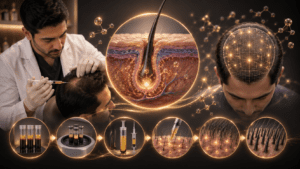
One of the biggest misconceptions about hair loss treatment is that every thinning area requires new hair.
In reality, many people already have hair follicles present in those areas the follicles simply are not functioning at their full potential.
Modern hair re-growth treatments aim to:
- Improve follicle health.
- Support blood supply.
- Enhance cellular activity.
- Reduce ongoing miniaturization.
- Improve scalp environment.
- Stimulate healthier hair growth cycles.
In simple terms, the goal is often to help existing follicles perform better not necessarily replace them.
Hair Transplants Do Not Create New Hair
This is another surprising fact.
A hair transplant does not create new hair follicles , It simply relocates existing follicles from one area of the scalp to another , The donor hair usually comes from the back or sides of the scalp , These follicles are moved into areas with reduced density , The procedure can be highly effective when performed on suitable candidates However, it does not stop the underlying hair loss process , If existing hair continues to weaken, further thinning may still occur around transplanted areas.
This is why maintaining native hair remains extremely important , Even for patients who eventually undergo transplantation.
Many People Seek Treatment Too Early For A Transplant

As dermatologists, we often see patients who notice early thinning and immediately assume surgery is necessary.
The reality is often very different.
- Many still have a substantial number of active follicles.
- Their hair density has decreased.
- Their hair strands have become thinner.
But the follicles remain present , In these situations, preserving and strengthening existing hair may be a more logical first step than surgery the earlier intervention begins, the greater the opportunity to protect existing hair.
Understanding The Hair Growth Cycle

Hair does not grow continuously every follicle follows a natural cycle :
- Growth phase.
- Transition phase.
- Resting phase.
- Shedding phase.
Various factors can disrupt this cycle.
- Stress.
- Hormonal changes.
- Nutritional deficiencies.
- Genetics.
- Illness.
- Inflammation.
When this happens, more follicles may enter the shedding phase while fewer remain actively growing the result is visible thinning & many hair re-growth treatments focus on encouraging follicles to spend more time in the active growth phase this helps improve overall density and hair quality over time.
The Role Of Regenerative Hair Treatments
One of the most exciting developments in modern hair restoration is the rise of regenerative medicine these treatments are designed to support the scalp’s natural repair and regeneration processes rather than adding artificial hair, the goal is to improve the environment around existing follicles this may help create conditions that are more favorable for healthy growth the concept is simple if the follicle is still alive, improving its environment may improve its performance while results vary between individuals, many patients experience improvements in hair thickness, density, and overall hair quality when treatment is started at the appropriate stage.
Timing Matters More Than Most People Realize
Hair loss is often progressive follicles typically weaken gradually rather than disappearing overnight.
This creates a window of opportunity during this stage, hair may look thinner but many follicles remain viable once follicles become permanently inactive for extended periods, recovery becomes significantly more challenging this is why early evaluation is so important patients who seek help sooner often have more treatment options available.
Why Two People With Similar Hair Loss May Need Different Treatments
No two scalps are exactly alike.
One person may have genetic hair thinning , another may have stress-related shedding someone else may have nutritional deficiencies , fourth may have hormonal factors contributing to hair loss even if the visible thinning looks similar, the underlying causes may be completely different.
This is why personalized diagnosis is essential successful treatment depends on understanding why the hair loss is occurring—not simply where it is occurring.
Hair Transplants And Hair Re-Growth Treatments Often Work Together
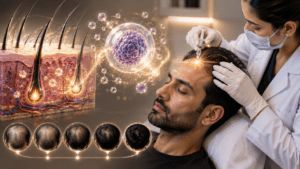
Many people think they must choose between a transplant and non-surgical treatment.
In reality, these approaches are often complementary.
- Hair re-growth treatments may help preserve existing hair.
- Hair transplantation may restore density in areas where follicles are no longer viable.
- The goal is not choosing one side.
- The goal is creating the best long-term strategy for each individual.
- For some patients, non-surgical treatment alone may be sufficient.
- For others, a combination approach may produce the best outcome.
The Emotional Side Of Hair Loss
Hair loss is rarely just about appearance.
- It affects confidence.
- Self-image.
- Social interactions.
- Photographs.
- Professional life.
- Relationships.
Many patients tell us they feel older than they actually are others feel they are slowly losing a part of their identity this is why treatment should never focus solely on hair it should focus on the person experiencing the hair loss behind every thinning hairline is someone looking for answers and often, what they need most is clarity.
A Final Thought
Not every patient with hair loss needs a hair transplant many people still have active follicles capable of producing healthier hair the challenge is identifying those follicles before they become permanently inactive.
Hair re-growth treatments work because they focus on supporting, strengthening, and preserving existing hair.
- They are not about creating something from nothing.
- They are about helping living follicles function better.
The earlier hair loss is understood, the greater the opportunity to protect what is already there because sometimes the best way to restore hair is not to replace it.