
There comes a moment when many people look in the mirror and notice something has changed.

- The skin doesn’t look quite as firm.
- The jawline isn’t as sharp.
- The cheeks seem slightly flatter.
- Fine lines that once appeared only when smiling now seem to stay longer.
At first, it is easy to blame stress.
- A few sleepless nights.
- A busy schedule.
- Too much screen time.
But then the changes continue , And one question starts to arise:
“Why does it feel like aging suddenly speeds up after 30?”
The answer lies largely in a remarkable protein that most people have heard of but few truly understand , It is one of the most important building blocks of youthful skin and the story of aging is, in many ways, the story of collagen loss.
What Exactly Is Collagen?
Imagine building a house , You can have beautiful paint, expensive furniture, and elegant decorations but without a strong framework, the structure begins to weaken , Collagen is that framework for your skin , It is the most abundant protein in the human body and serves as the skin’s internal support system.
Collagen provides:
- Firmness.
- Strength.
- Elasticity.
- Structure.
- Smoothness.
In youthful skin, collagen fibers are dense, organized, and abundant , This creates the firm, plump appearance we often associate with younger skin , When collagen levels are high, the skin can better resist sagging, wrinkles, and volume loss.
The Surprising Truth About Aging
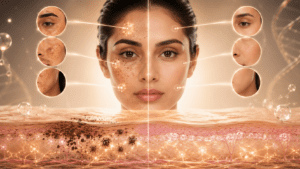
Most people believe aging begins when wrinkles become visible.
In reality, aging starts much earlier, Research shows that collagen production begins to decline as early as the mid-to-late twenties , By the age of 30, many individuals are already producing less collagen than they did during their younger years , On average, collagen production decreases by approximately 1% each year after adulthood.
One percent may not sound dramatic But year after year, that decline accumulates , The changes are gradual , Then one day, they become visible.
Why Aging Seems Faster After 30
Many patients tell us the same thing.
- “I looked almost the same throughout my twenties.”
- “Then suddenly everything changed after thirty.”
This feeling is not imagined , Several biological processes begin accelerating around this stage of life.
- Collagen production slows down.
- Cell turnover becomes less efficient.
- Skin hydration gradually decreases.
- Environmental damage starts accumulating.
The body’s natural repair mechanisms become less effective , the result is that changes which were previously invisible begin appearing on the surface.
- Fine lines become noticeable.
- Skin recovery slows.
- Volume loss begins.
- Skin firmness decreases.
The face gradually loses some of the structural support it once had.
The Biggest Collagen Destroyer Isn’t Age
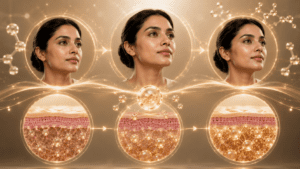
Surprisingly, age is not the only reason collagen declines , In fact, some people in their forties have better collagen quality than others in their twenties.
Why? Because lifestyle matters.
One of the biggest causes of premature collagen loss is
- Sun exposure
- Ultraviolet radiation penetrates the skin and activates enzymes that break down collagen fibers.
This process is known as photoaging.
It is one of the primary reasons why exposed areas of the body often age faster than protected areas , many studies suggest that a significant portion of visible facial aging is related to cumulative sun exposure rather than chronological age alone , this is why sunscreen remains one of the most powerful anti-aging tools available.
Stress and Collagen Loss
- Modern life is stressful.
- Deadlines.
- Financial pressures.
- Family responsibilities.
- Constant digital stimulation.
While stress affects the mind, it also affects the skin , Chronic stress increases cortisol levels , Elevated cortisol can contribute to inflammation and impair collagen production over time , Many people notice their skin looking tired, dull, or aged during prolonged periods of stress.
The connection is real , Your skin often reflects what your body is experiencing internally.
The Role of Sleep
People often call sleep “beauty rest.” Science suggests there is truth behind the phrase. During sleep, the body enters repair mode , Cellular regeneration increases , Damage accumulated throughout the day begins to be repaired , Collagen synthesis is supported & When sleep becomes chronically inadequate, recovery processes become less efficient.
Over time, this may contribute to accelerated visible aging , Good skincare helps But healthy sleep remains one of the most underrated beauty treatments available.
Can Diet Affect Collagen?
Absolutely.
- Collagen production requires amino acids, vitamins, and minerals
- Protein provides the building blocks ,
- Vitamin C plays a critical role in collagen synthesis
- Zinc and copper support tissue repair.
A balanced diet provides the nutrients the skin needs to maintain itself.
On the other hand, excessive sugar consumption may contribute to a process called glycation. During glycation, sugar molecules bind to collagen fibers, making them weaker and less flexible. This can contribute to premature skin aging over time , Once again, what happens inside the body often becomes visible on the skin.
What Does Collagen Loss Look Like?
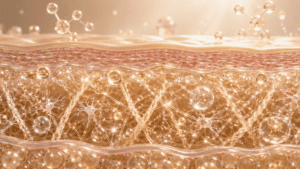
Most people imagine wrinkles But collagen loss affects much more than that.
You may notice:
- Fine lines around the eyes.
- Smile lines becoming deeper.
- Loss of cheek volume.
- A softer jawline.
- Skin laxity around the neck.
- Larger-looking pores.
- Less skin bounce and elasticity.
- Slower recovery after skin injury.
- These changes usually happen gradually.
- The mirror rarely reveals them overnight.
Instead, they appear quietly over years.
Can Collagen Loss Be Slowed?
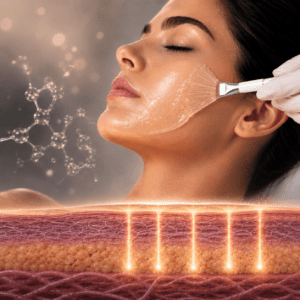
Aging is natural.
No treatment can stop time , However, science has shown that certain habits can help support collagen preservation.
- Daily sunscreen use.
- Adequate sleep.
- Balanced nutrition.
- Regular exercise.
- Stress management.
- Avoiding smoking.
- Consistent skincare.
Modern dermatology also offers treatments designed to stimulate collagen production and support skin quality.
- The goal is not to look twenty forever.
- The goal is to help the skin remain healthier, stronger, and more resilient as it ages.
A Final Thought
Many people view aging as something that suddenly happens but aging is actually a series of small biological changes that accumulate over time , Collagen loss is one of the most important of those changes.
- Every smile.
- Every year.
- Every hour spent in the sun.
- Every night of poor sleep.
- Every healthy choice.
They all contribute to the story your skin eventually tells , the good news is that understanding collagen gives us something powerful.
Awareness. Because when we understand why the skin changes, we can make better decisions about how we care for it .