
Have you ever noticed that your skin seems to misbehave when your digestion isn’t at its best?
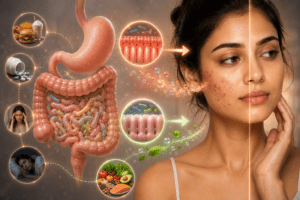
- You feel bloated for a few days.
- Your stomach feels uncomfortable.
- Your eating habits go off track.
- your skin starts breaking out.
A new pimple appears.
- Old acne becomes more inflamed.
- Pigmentation seems darker.
- Your skin looks dull and tired.
Most people think these are completely separate problems.
- One belongs to the stomach.
- The other belongs to the skin.
But what if they are more connected than we realize?
Over the past few years, science has begun uncovering something fascinating: the health of your gut may have a much bigger influence on your skin than we once thought while digestion is not the only cause of acne or pigmentation, it is increasingly being recognized as an important piece of the puzzle.
Your Gut Is More Than Just a Digestive Organ
When people think about the gut, they usually think about digesting food But your gut does much more than that.
Inside your digestive system live trillions of microorganisms, including bacteria, fungi, and other microbes. Together, they form what scientists call the “gut microbiome.” These tiny organisms help digest food, produce important nutrients, support immunity, and communicate with different parts of the body—including the skin , In fact, nearly 70% of the body’s immune system is closely linked to the gut , This means that when the gut is healthy, many systems in the body tend to function better , When the gut is struggling, the effects may show up in unexpected places.
Including your skin.
Why Some People Have Clear Skin Despite Eating Everything
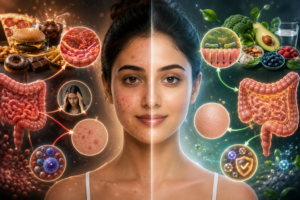
We’ve all met someone like this.
- They eat spicy food.
- They enjoy desserts.
- They rarely think about skincare.
Yet their skin remains clear , Then there are people who follow strict skincare routines, drink plenty of water, and use expensive products—but still struggle with acne and pigmentation.
Why? Because skin health is influenced by much more than what we apply on the surface.
- Hormones.
- Genetics.
- Stress.
- Sleep.
- Lifestyle.
- And increasingly, gut health.
The skin is often a reflection of what’s happening inside the body Sometimes, the message isn’t coming from the face , It’s coming from the digestive system.
The Link Between Gut Health and Acne
Acne develops when oil production, inflammation, bacteria, and clogged pores come together But one factor often receives less attention: inflammation inside the body.
When the gut microbiome becomes imbalanced , a condition often referred to as dysbiosis , it may contribute to increased systemic inflammation , Think of inflammation as a fire.
When the body experiences ongoing internal inflammation, the skin may become more reactive.
- Acne lesions may appear redder.
- Existing breakouts may take longer to heal.
- The skin may become more sensitive.
Research suggests that gut imbalance can influence:
- Immune responses
- Hormonal activity
- Inflammatory pathways
That may contribute to acne in susceptible individuals , This doesn’t mean every acne patient has a gut problem But it does mean that gut health deserves attention, especially in persistent or recurring cases.
Can Digestion Affect Pigmentation?
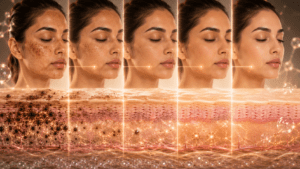
Pigmentation is more complex.
Conditions such as :
- Melasma
- Post-inflammatory pigmentation
- Uneven skin tone
Influenced by multiple factors including :
- Sun exposure
- Hormones
- Genetics
- Inflammation
- Skin injury.
However, chronic inflammation within the body may indirectly affect pigmentation , When the body experiences ongoing inflammatory stress, the skin’s healing response can become exaggerated. This may increase the likelihood of darker marks after acne , Pigmentation may linger for longer periods & The skin may appear less bright and more uneven.
Additionally, poor digestion can sometimes affect the absorption of important nutrients such as
- Iron
- Zinc
- Vitamin B12
- micronutrients that support healthy skin function.
Healthy skin requires healthy nutrition And healthy nutrition requires effective absorption.
Even the best diet cannot fully help if the body struggles to utilize those nutrients properly.
The Stress-Gut-Skin Triangle
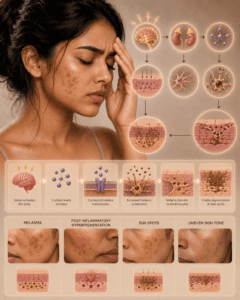
One of the most interesting discoveries in modern medicine is how closely stress, digestion, and skin health are connected.
Think about what happens during stressful periods.
- Deadlines increase.
- Sleep decreases.
- Eating habits change.
- Digestion becomes irregular.
- Your skin starts reacting.
This is not a coincidence.
The brain, gut, and skin communicate constantly through hormones, nerves, and immune signals , Scientists often refer to this as the gut-brain-skin axis & When stress levels rise, the gut microbiome may become disrupted.
- Digestive symptoms may worsen.
- Inflammation may increase.
The skin can become one of the first places where these changes become visible , this is why many people notice flare-ups of acne before exams, important meetings, weddings, or emotionally difficult periods in life.
The skin is often responding to much more than what is happening on its surface.
Signs That Gut Health May Need Attention
Not everyone with acne or pigmentation has digestive issues , However, some clues may suggest that gut health deserves evaluation.
These may include:
- Frequent bloating.
- Acidity or reflux.
- Irregular bowel movements.
- Excessive gas.
- Food sensitivities.
- Persistent fatigue.
- Poor dietary habits.
- Repeated courses of antibiotics.
These signs do not automatically mean they are causing skin problems But they may indicate that looking beyond the skin could be beneficial.
What Can You Do?

The goal is not to become obsessed with your gut. The goal is balance like :
- Eating a varied and nutrient-rich diet.
- Including fruits, vegetables, and fibre.
- Staying hydrated.
- Managing stress.
- Getting adequate sleep.
- Exercising regularly.
Avoiding excessive consumption of highly processed foods , Most importantly, avoid looking for a single miracle food or supplement , Skin health rarely depends on one ingredient & It is usually the result of many small habits working together over time.
A Final Thought
As dermatologists, we often remind patients that the skin is the body’s largest visible organ But perhaps the most important word is visible.
The skin is often showing us what is happening beneath the surface.
- Acne is not always just about oil.
- Pigmentation is not always just about sunlight.
- Sometimes, the body is sending signals from deeper within.
- The gut and the skin may seem like distant organs.
- Yet science continues to reveal how closely connected they truly are.
Taking care of your skin remains important But taking care of your overall health , including your digestion, may be just as important Because healthy skin is rarely built only from the outside.
It is often nurtured from within.