Refining Nasal Profile and Creating a Smoother Facial Contour
Patient
Ishita Deshmukh
Age / Gender
30 Years / Female
Duration
1 Session | Result Assessment After 10–14 Days
Concern
Mild nasal bridge irregularities, limited dorsal definition and an uneven nasal profile affecting overall facial proportions.

Patient Overview
Ishita sought a subtle improvement in her nasal profile without undergoing surgical rhinoplasty. Her primary concern was an uneven transition between the nasal bridge and tip, which affected the smoothness of her nasal outline. Non-Surgical Nose Reshaping was selected to enhance dorsal definition and create a more proportionate appearance while preserving her natural facial features.
Concern
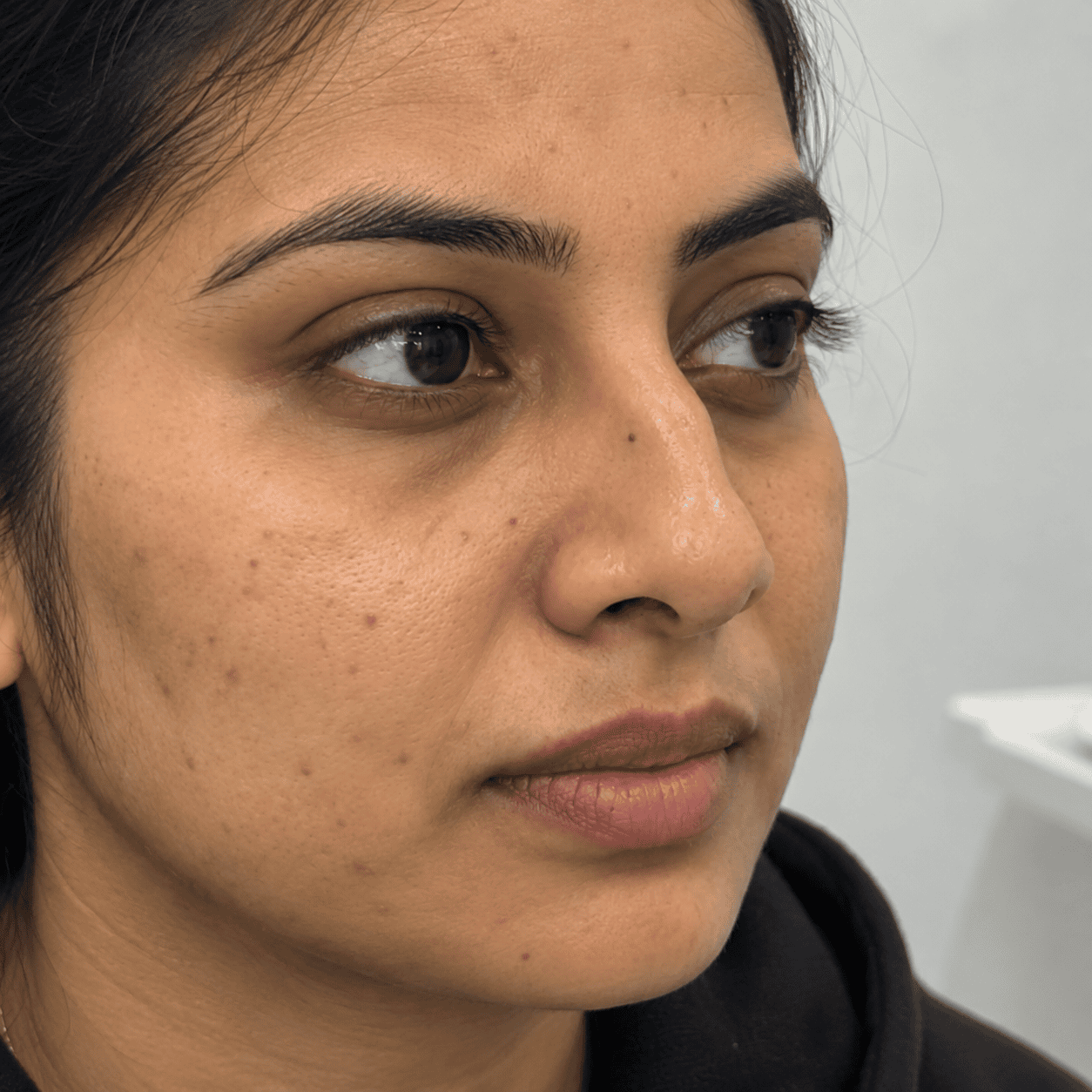
The initial photograph shows a relatively soft nasal bridge with minor irregularities along the dorsal contour. The treatment focused on smoothing these variations, improving bridge continuity and creating a more defined profile without significantly changing the nose's natural shape.
Medical History
No significant medical conditions were reported. The patient underwent a clinical assessment to evaluate nasal anatomy, vascular considerations and suitability for injectable contouring.
Lifestyle Factors
No specific lifestyle factors contributed to Ishita's nasal concerns. The treatment decision was based on her anatomical characteristics, aesthetic preferences and desire for a non-surgical procedure.
Diagnosis Summary
The aesthetic assessment identified mild dorsal contour irregularities and reduced nasal bridge definition. The treatment objective was to improve profile continuity and enhance nasal proportions without modifying the underlying bone or cartilage.
Clinical Results
The photographic comparison suggests a smoother nasal dorsum, improved bridge continuity and a more defined central nasal profile. The transition between the bridge and tip appears more consistent, contributing to improved facial balance. The result remains subtle, although differences in lighting and photographic positioning prevent precise measurement of dimensional changes.
Before

After
Treatment Plan
Non-Surgical Nose Reshaping / Liquid Rhinoplasty
A personalised dermal filler procedure was planned according to Ishita's nasal anatomy and desired aesthetic outcome. Carefully positioned filler was used to smooth selected dorsal irregularities, improve bridge continuity and enhance the visual transition toward the nasal tip. The procedure focused on conservative contour correction rather than reducing nasal size or permanently altering its underlying structure.
Duration & Frequency
The treatment involved one session lasting approximately 30–45 minutes. Initial swelling generally subsides within 3–7 days, while the nasal contour becomes more established over the following days. The result was assessed approximately 10–14 days after treatment, allowing sufficient time for early swelling to settle.

Progress Timeline
Measured Outcomes
Smoother
Dorsal Profile
Enhanced
Nasal Definition
Improved
Bridge Continuity
Balanced
Facial Proportions

Doctor's Clinical Insight
“A good non-surgical nose filler result should be subtle enough that the improvement complements the face rather than becoming the first thing people notice. For a mild contour irregularity, conservative correction can create a smoother nasal line and improve the overall relationship between the nose and surrounding features. Careful anatomical assessment and appropriate patient selection are essential because nasal filler treatment requires a high level of technical precision.”
Dr. Ashok Patel

Patient Experience
“I wanted a small improvement in the shape of my nose rather than a dramatic change. My main concern was the unevenness along the bridge. After the treatment settled, I noticed that the profile looked smoother and more defined. It still looks natural, which was exactly what I wanted.”
Ishita Deshmukh
Start With a Personalised Beard Assessment
Individual nasal anatomy, facial proportions and aesthetic preferences determine whether non-surgical contouring is suitable. A detailed consultation helps evaluate treatment options, explain potential risks and establish realistic expectations regarding results, recovery and treatment longevity.