
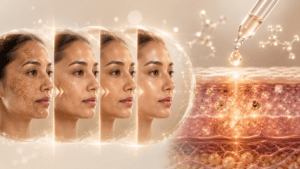
When patients come to Brilliance Cosmocare, DN Nagar, Andheri West, Mumbai with melasma, post-acne marks or uneven pigmentation, one of the most common questions is:
“How does pigmentation treatment actually make my skin look more even?”
The answer is important because pigmentation treatment does not simply “erase colour” from the skin.
Different treatments work in different ways. Some reduce excessive melanin production. Some increase the removal of pigment-containing surface cells. Some help control inflammation. Others target pigment with carefully selected energy-based devices. And in melasma, controlling the triggers that stimulate pigmentation is often just as important as treating the pigment already visible in the skin.
After more than 10+ years of experience in aesthetic treatments, our approach at Brilliance Cosmocare is to explain pigmentation treatment through three questions:
- How is excessive pigmentation reduced?
- How are different treatments used?
- How should treatment differ depending on the skin area involved?
How Does Pigmentation Develop in the Skin?
Skin colour is influenced by melanin, which is produced by cells called melanocytes.
When melanin production becomes excessive or uneven, certain areas may appear darker than the surrounding skin.
But the reason for that excess pigment can differ.
Melasma is a chronic pigmentary condition influenced by factors including light exposure, hormones and individual susceptibility. Post-inflammatory hyperpigmentation develops after inflammation or injury, such as acne. Because these conditions arise differently, they should not automatically be treated in exactly the same way.
This is why the first part of effective pigmentation treatment is understanding what is driving the pigment rather than immediately selecting a laser or peel.
How Do Topical Pigmentation Treatments Affect the Skin?
Topical treatments are an important part of melasma management.
Certain ingredients work by reducing pathways involved in excessive melanin formation, while others increase skin-cell turnover or modify inflammation.
One well-studied prescription approach combines hydroquinone, tretinoin and fluocinolone acetonide. In a randomized trial involving Asian patients with moderate-to-severe melasma, this triple combination produced greater improvement than hydroquinone alone over eight weeks.
This demonstrates an important principle:
Pigmentation treatment often works gradually by changing how pigment is produced and processed within the skin.
It does not usually work like paint being wiped from the surface.
How Does Hydroquinone Affect Pigmentation?
Hydroquinone is used medically to reduce excessive melanin production.
Rather than physically removing an existing dark patch instantly, it interferes with processes involved in pigment formation.
This means improvement generally develops over time.
It is also one reason prescription-strength pigmentation treatments should be used appropriately rather than indefinitely or without guidance.
For selected melasma patients, combination therapy can work better than relying on one depigmenting ingredient alone.
How Does Tranexamic Acid Help Melasma?
Tranexamic acid has also been studied in melasma treatment.
It can be used in different forms, including topical and—in carefully selected patients—oral approaches. A 2025 randomized clinical trial comparing oral and topical tranexamic acid found improvement in melasma severity with both approaches, although administration route and tolerability need to be considered individually.
An Indian randomized study has also compared topical tranexamic acid with hydroquinone for melasma, demonstrating that topical tranexamic acid can form part of the treatment options available for Indian skin.
This does not mean tranexamic acid is automatically appropriate for everybody.
Especially with oral treatment, medical history and safety assessment matter.
How Does Sunscreen Actually Affect Melasma Treatment?
Many patients think sunscreen is simply used to prevent tanning.
For melasma, its role is much more important.
Light exposure can stimulate pigmentation pathways and contribute to melasma persistence or recurrence.
In a randomized study, patients using sunscreen that protected against both ultraviolet and visible light showed better melasma improvement than patients using UV-only sunscreen when both groups were also using hydroquinone treatment.
Another randomized study found that protection against visible light helped reduce melasma relapse.
This means pigmentation treatment is not simply:
Treat the pigment in the clinic.
It is also:
Reduce the environmental signals encouraging the skin to produce more pigment.
How Does Pigmentation Treatment Affect the Cheeks?
The cheeks are among the most common areas affected by melasma.
When pigmentation is symmetrical across both cheeks, treatment often needs to be planned across the broader affected region rather than treating individual spots one by one.
For cheek melasma, the objective may involve:
- Reducing excessive pigmentation gradually
- Preventing further light-triggered darkening
- Maintaining an even treatment response
- Avoiding unnecessary inflammation
This last point is particularly important.
If treatment irritates the cheeks excessively, the resulting inflammation can itself contribute to additional pigmentation in susceptible skin.
How Does Treatment Affect Forehead Pigmentation?
The forehead is another area where melasma can be noticeable.
Because it is exposed to sunlight and visible light throughout the day, treating forehead pigmentation without consistent photoprotection can make long-term control more difficult.
This is why topical treatment and photoprotection often work together rather than being treated as separate parts of the plan. Controlled studies have shown that broader-spectrum light protection improves melasma outcomes when added to depigmenting treatment.
The goal is therefore not simply to reduce the pigment that is already there.
It is also to reduce the chance of continuous restimulation.
How Does Treatment Affect Upper-Lip Pigmentation?
Pigmentation around the upper lip can be particularly noticeable because even a relatively small amount of darkening can create a shadow-like appearance.
This area often requires conservative treatment because it is constantly exposed to movement, skincare, hair-removal practices and environmental irritation.
If irritation itself contributes to pigmentation, repeatedly treating the area aggressively can be counterproductive.
The treatment approach should therefore depend on whether the upper-lip pigmentation is part of melasma, post-inflammatory pigmentation or another cause.
How Does Treatment Affect Jawline Pigmentation?
Jawline pigmentation can arise from several different mechanisms.
In some patients it forms part of a melasma pattern.
In others, repeated irritation, acne, hair removal or inflammation may contribute.
This is why we do not automatically use the same protocol on the jawline that we would use for central cheek melasma.
The main question is:
Is the pigmentation being driven by melasma, or is inflammation continuously creating new pigment?
If inflammation remains active, treating only the visible dark colour may provide incomplete results.
How Are Post-Acne Pigmentation Areas Treated?
Post-acne pigmentation is different from melasma because the pigment appears after inflammation.
The treatment therefore has two goals:
Reduce existing pigmentation + prevent new inflammatory acne lesions from creating more marks.
If the acne continues while only the pigmentation is treated, the patient may continuously develop new dark spots.
This is why pigmentation management should sometimes involve treating the underlying inflammatory trigger rather than simply repeatedly removing marks.
How Do Chemical Peels Affect Pigmentation?
Chemical peels can be used in selected pigmentation treatment plans to accelerate controlled exfoliation and improve the appearance of superficial pigment.
But stronger does not automatically mean better.
When a peel creates excessive inflammation, especially in pigmentation-prone skin, there is a possibility of post-inflammatory darkening.
This is one reason treatment intensity should be selected according to the patient’s skin response rather than simply using the highest concentration possible.

The aim is controlled improvement not maximum irritation.
How Does Microneedling Affect Melasma?
Microneedling has also been studied as an adjunctive treatment for melasma, including methods that improve the delivery of topical agents.
A 2024 randomized controlled trial compared microneedling combined with topical tranexamic acid against a modified Kligman topical formula and assessed both treatment response and durability.
Another controlled study found that microneedling and Q-switched Nd laser produced similar improvement when both were combined with topical tranexamic acid, although microneedling involved greater downtime.
This reinforces that pigmentation treatment does not need to rely on one universal technology.
Different techniques can be selected according to the patient’s pigmentation and treatment goals.
How Does Laser Treatment Affect Pigmentation?
Lasers can target pigment using specific wavelengths and energy settings.
For selected patients, laser treatment can reduce visible pigmentation.
But melasma is not simply a collection of isolated pigment particles that should always be destroyed aggressively.
A 2025 randomized placebo-controlled split-face trial found that adding low-fluence Q-switched Nd laser did not provide significant additional improvement beyond combination topical therapy in the study population.
Another clinical study of low-fluence Q-switched Nd reported improvement in many patients but also documented mottled hypopigmentation and rebound hyperpigmentation in some cases.
This is why, at Brilliance Cosmocare, our approach is not:
“More laser = faster pigmentation removal.”
Laser is a tool.
Whether it belongs in the treatment plan depends on the condition, skin response and previous treatment history.
How Can Pigmentation Treatment Accidentally Make Skin Darker?
This is one of the most important things patients should understand.
Pigment-producing cells can respond to inflammation.
Therefore, if a pigmentation treatment produces excessive irritation, inflammation may sometimes result in additional pigment formation.
This is especially relevant in patients whose skin is already prone to post-inflammatory hyperpigmentation.
The sequence can become:
Aggressive treatment → excessive inflammation → pigment response → darker marks.
That is why careful treatment is often more effective than aggressive treatment.
How Quickly Does Pigmentation Improve?
Pigmentation treatment should generally be thought of as a progressive process rather than an instant transformation.
For example, the randomized triple-combination melasma trial assessed treatment over an eight-week period, rather than judging success after a single application.
Clinical trials of laser, tranexamic acid and microneedling likewise commonly evaluate changes over multiple sessions or several weeks.
The timeline therefore depends on:
- Type of pigmentation
- Depth and severity
- Treatment selected
- Sun exposure
- Skin response
- Ongoing inflammation
- Patient adherence
How Do We Approach Melasma and Pigmentation at Brilliance Cosmocare?
At Brilliance Cosmocare, after more than 10+ years of experience in aesthetic care, we do not approach pigmentation as:
Dark patch → strongest available treatment.
We first ask:
Where is the pigmentation?
Is it melasma or post-inflammatory pigmentation?
Are active acne lesions still creating new marks?
Has previous treatment irritated the skin?
Is light exposure contributing to recurrence?
Would topical treatment be enough, or is a procedure justified?
How can we improve pigmentation without unnecessarily inflaming the skin?
These questions help determine how the treatment should affect each area.
Final Thoughts
So, how does Melasma and Pigmentation Treatment affect the skin?
Different treatments work through different pathways.
Topical medicines can reduce excessive pigment formation and influence skin-cell turnover. Combination topical therapy has demonstrated effectiveness in controlled melasma trials.
Photoprotection helps reduce stimulation from ultraviolet and visible light and can improve treatment response and reduce recurrence.
Tranexamic acid may reduce melasma severity in selected patients through topical or medically supervised systemic approaches.
Microneedling and laser-based treatments can be useful in selected cases, but they should be chosen carefully because aggressive treatment can create irritation, rebound pigmentation or unwanted light spots.
At Brilliance Cosmocare, treatment may need to be adapted across the:
- Cheeks
- Forehead
- Upper lip
- Nose
- Jawline
- Post-acne areas
- Selected neck or body pigmentation areas
The goal is not to remove as much pigment as aggressively as possible.
It is to identify why pigment is being produced, reduce abnormal pigmentation gradually, protect the skin from further stimulation and avoid creating unnecessary inflammation that could make the problem worse.
Because successful pigmentation treatment is not simply about making a dark area lighter.
It is about helping the skin move toward a more even, controlled and sustainable pigmentation pattern while respecting the patient’s natural skin tone.