

When patients notice brown patches, dark spots, post-acne marks or an uneven skin tone, they often describe everything using one word:
“Pigmentation.”
But pigmentation is not one single skin condition.
At Brilliance Cosmocare, DN Nagar, Andheri West, Mumbai, patients commonly ask us:
“What exactly is melasma?”
“Is every dark patch pigmentation?”
and
“Is pigmentation treatment the best option for my skin?”
After more than 10+ years of experience in aesthetic treatments, our approach is to first identify what type of pigmentation is present before deciding how it should be treated.
This is particularly important because melasma, post-acne pigmentation, sun-related spots and pigmentation caused by inflammation can look similar to patients but may require different treatment strategies.
What Does “Pigmentation” Actually Mean?
The natural colour of our skin is influenced largely by melanin, a pigment produced by specialised cells called melanocytes.
Pigmentation becomes an aesthetic concern when certain areas appear noticeably darker than the surrounding skin.
This is broadly referred to as hyperpigmentation.
Hyperpigmentation can appear as:
- Individual dark spots
- Brown patches
- Post-acne marks
- Uneven facial pigmentation
- Larger areas of discolouration
- Pigmentation after inflammation or irritation
- Sun-related spots
- Melasma
So when someone says:
“I have pigmentation,”
that describes what they can see.
It does not necessarily tell us why it happened.
That distinction is extremely important.
What Is Melasma?
Melasma is a specific type of acquired hyperpigmentation.
The American Academy of Dermatology describes melasma as a condition that causes patches and spots that are darker than a person’s natural skin tone, usually affecting the face.
A 2026 clinical review describes melasma as a chronic acquired pigmentary disorder characterised by symmetrical brown-to-grey patches, most commonly on sun-exposed facial areas.
Melasma commonly follows several facial patterns:
Centrofacial: involving areas such as the forehead, cheeks, upper lip, nose and chin.
Malar: mainly affecting the cheeks.
Mandibular: involving the jawline or lower facial region.
This is why symmetrical pigmentation across both cheeks or patches developing around the forehead and upper lip may look very different from isolated acne marks.
Is Melasma the Same as Normal Pigmentation?
No.
Everyone naturally has skin pigmentation.
Melanin is a normal and important part of human skin.
Having naturally brown or darker skin is not a condition that requires treatment.
Melasma refers to an acquired pattern of excess pigmentation that appears darker than the surrounding natural skin tone.
This distinction matters because pigmentation treatment should never be marketed as an attempt to make someone’s natural complexion “fair.”
At Brilliance Cosmocare, the objective should be to address unwanted uneven pigmentation, not to suggest that lighter skin is healthier or more desirable.
What Is Post-Inflammatory Hyperpigmentation?
Another very common pigmentation concern is post-inflammatory hyperpigmentation, often abbreviated as PIH.
This occurs after the skin has experienced inflammation or injury.
Common examples include pigmentation left after:
- Acne
- Skin irritation
- Eczema or dermatitis
- Scratching
- Burns
- Certain cosmetic procedures
- Other inflammatory skin conditions
A 2024 systematic review notes that PIH can affect all skin types but has a stronger tendency to affect people with darker skin tones.
This explains the common patient complaint:
“My pimples have gone, but every pimple has left a brown mark.”
That is fundamentally different from classic melasma.
Is a Post-Acne Dark Mark the Same as an Acne Scar?
Not necessarily.
This is another common misunderstanding.
A flat brown mark following acne may be post-inflammatory pigmentation.
An acne scar usually involves a structural change in the skin, such as:
- A depression
- A raised scar
- Uneven texture
- Loss of normal skin structure
A patient may have pigmentation and acne scars at the same time, but they are not identical problems.
This is why a treatment designed to improve dark colour may not completely correct a deep acne scar.
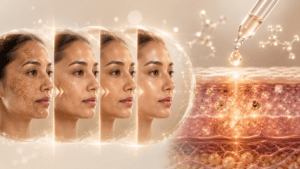
What Are Sunspots and Other Pigmentation?
Not every isolated brown spot is melasma either.
Long-term sun exposure can contribute to localised pigmentation such as solar lentigines, often referred to as sunspots.
Other pigmentation can also occur due to:
- Medication
- Hormonal influences
- Inflammation
- Repeated irritation
- Underlying skin conditions
- Previous procedures
Current clinical guidance specifically emphasises distinguishing melasma from other pigmentation disorders, including post-inflammatory hyperpigmentation, lentigines and drug-related pigmentation.
This is why it can be misleading to offer:
“One pigmentation treatment for every dark spot.”
What Causes Melasma?
Melasma is considered multifactorial.
This means there is usually not one single cause.
Current evidence identifies important contributors including:
- Ultraviolet light
- Visible light
- Hormonal influences
- Pregnancy
- Certain hormonal medications
- Genetic susceptibility
- Individual skin biology
The 2026 NCBI clinical review describes light exposure as one of the most consistent modifiable triggers and notes that both ultraviolet and visible light can contribute to melasma.
Hormonal influences are also important, which is why melasma often appears or becomes more noticeable during pregnancy or with hormonal medications.
This complexity is one reason melasma can be more difficult to manage than a single isolated dark spot.
Is Melasma Permanent?
Melasma should generally be viewed as a chronic and relapsing pigmentation disorder.
This does not mean improvement is impossible.
It means patients should be cautious about claims such as:
“Permanent melasma removal in one session.”
The American Academy of Dermatology notes that treatment can fade melasma, but the condition can return, particularly without ongoing sun protection.
Current clinical guidance similarly focuses on long-term control and prevention of recurrence, rather than treating initial pigment clearance as a permanent cure.
This difference between control and permanent removal is essential when deciding whether a treatment plan is realistic.
What Is Melasma and Pigmentation Treatment?
“Pigmentation Treatment” is therefore not one procedure.
It is an umbrella term for treatments selected according to the cause and type of pigmentation.
Depending on the diagnosis, pigmentation management may involve:
- Sun and visible-light protection
- Topical depigmenting medicines
- Medical skincare
- Chemical peels
- Microneedling-based approaches
- Tranexamic-acid-based treatment in selected patients
- Laser or light-based procedures in selected cases
- Combination treatment
A 2024 review of melasma management notes that multiple therapies are often combined because melasma has several contributing biological factors and remains challenging to manage over the medium and long term.
This means the word “treatment” should describe a personalised strategy—not automatically one machine or one product.
Is Laser the Best Treatment for Melasma?
Not automatically.
Many patients assume:
“Pigmentation = laser.”
That is too simplistic.
Laser and other energy-based treatments may have a role in selected cases, but they are not automatically the first or best choice for every person with melasma.
The American Academy of Dermatology notes that melasma treatment commonly begins with sun protection and topical treatment, with procedures added when appropriate.
This is particularly relevant for darker skin tones because irritation from some treatments can actually worsen pigmentation.
Therefore, the most powerful machine is not automatically the most appropriate treatment.

Is a Chemical Peel the Best Option?
Again, not universally.
A chemical peel may be useful for certain pigmentation concerns, but the strength and type of peel need to suit the patient’s skin and pigmentation.
If treatment produces excessive irritation, inflammation itself may contribute to additional pigmentation—particularly in more deeply pigmented skin.
This is why pigmentation treatment is not simply about using the strongest peel available.
Are Creams the Best Treatment?
Topical treatments are important in melasma management and may be sufficient for some patients.
However, there is also no single cream that is automatically best for everyone.
Different patients may require different active ingredients, strengths or combinations.
Long-standing, recurrent or more complex pigmentation may require treatment beyond topical skincare.
So the question should not be:
“Which pigmentation cream is strongest?”
It should be:
“Which treatment is appropriate for the pigmentation I actually have?”
What Is the Difference Between Treating Melasma and Treating Post-Acne Pigmentation?
The treatment goals may overlap, but the underlying problem is different.
With post-acne pigmentation, controlling ongoing acne and inflammation is often important because new breakouts can continuously create new marks.
With melasma, factors such as light exposure, hormonal influences and recurrence need greater consideration.
If those differences are ignored, a patient may continue receiving procedures without properly addressing what keeps creating the pigmentation.
Is Melasma and Pigmentation Treatment the Best Option?
If unwanted pigmentation is genuinely the patient’s primary concern, then a properly diagnosed pigmentation-management plan can be appropriate.
But there is no single treatment that deserves the title:
“Best pigmentation treatment for everybody.”
The appropriate treatment depends on whether the patient has:
- Melasma
- Post-inflammatory pigmentation
- Post-acne marks
- Sun-related spots
- Pigmentation following irritation
- Another pigmentary condition
The best strategy should match the diagnosis.
What Is Pigmentation Treatment Not?
Pigmentation treatment should not mean:
- Permanent fairness treatment.
- Making naturally brown skin white.
- Removing every dark mark with one laser session.
- Using the strongest possible peel.
- Treating every brown patch as melasma.
And most importantly:
- It should not mean treating an unexplained pigmented lesion cosmetically without first establishing what it is.
A new, unusual or changing pigmented lesion may require proper medical evaluation rather than cosmetic pigmentation treatment.
What Should “Best Treatment” Actually Mean?
At Brilliance Cosmocare, after more than 10+ years of experience in aesthetic care, we believe the word “best” should mean:
Best matched to the patient’s actual pigmentation concern.
Not:
- Most expensive
- Strongest laser
- Deepest peel
- Fastest advertised result
- Most trending procedure
- Treatment that promises maximum whitening
Sometimes topical treatment may be sufficient.
Sometimes procedures may be useful.
Sometimes combination management makes more sense.
And sometimes the first step should simply be confirming that the pigmentation is actually melasma.
What Is Our Approach at Brilliance Cosmocare?
At Brilliance Cosmocare, DN Nagar, Andheri West, Mumbai, when someone says:
“I want pigmentation treatment,”
we first think about:
- What type of pigmentation is present?
- Is the pattern consistent with melasma?
- Are the marks related to acne or inflammation?
- Is sun exposure contributing?
- Is there ongoing irritation?
- Has previous treatment made the pigmentation darker?
- Is the patient’s natural skin tone being confused with hyperpigmentation?
Only after answering those questions can a treatment category be appropriately selected.
Final Thoughts
So, what are Melasma and Pigmentation?
Pigmentation is a broad term describing changes in skin colour caused by increased or uneven pigment.
Melasma is a specific, commonly facial form of acquired hyperpigmentation that typically produces symmetrical brown-to-grey patches and often follows a chronic, recurrent course.
Post-acne pigmentation, sunspots and post-inflammatory pigmentation are separate concerns even though patients may visually describe all of them as “dark spots.”
And is pigmentation treatment the best option?
It can be but only when the correct pigmentary condition has been identified.
At Brilliance Cosmocare, our philosophy is straightforward:
Do not begin by asking which laser, peel or pigmentation treatment is strongest. Begin by identifying what the pigmentation actually is.
Because the best treatment for melasma may not be the best treatment for post-acne marks.
The best treatment for a sunspot may not be the best treatment for recurrent facial melasma.
And natural darker skin does not require treatment simply because it contains more pigment.
The better question is therefore:
“What type of pigmentation do I have, and which treatment strategy is most appropriate for that specific condition?”
That is the starting point for responsible pigmentation management.