
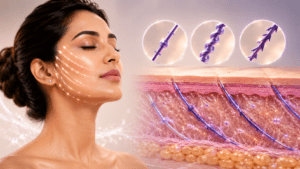
When patients notice that their cheeks are beginning to descend, the jawline looks softer, early jowls are appearing or the lower face is starting to look heavier, one of the treatments they may consider is a Thread Lift.
At Brilliance Cosmocare, DN Nagar, Andheri West, Mumbai, patients often ask us:
“How does putting threads under the skin actually lift my face?”
This is an important question because Thread Lift Treatment works very differently from fillers, Botox, HIFU or surgical facelift procedures.
After more than 10 years of experience in aesthetic treatments, we prefer to explain Thread Lift through two main effects:
First, the threads provide mechanical support and reposition selected facial tissues.
Second, absorbable thread materials can create a local tissue response around the thread, including collagen-related remodelling.
The American Society of Plastic Surgeons describes thread lifting as using absorbable, barbed sutures that can mechanically lift tissue while also stimulating collagen production in the treated skin.
Understanding these two effects makes it much easier to understand how Thread Lift affects sagging skin.
How Does Thread Lift Physically Lift Sagging Skin?
The most immediate effect of a lifting thread is mechanical repositioning.
As facial tissues age, they may gradually descend from their previous position. This can contribute to:
- Lower-looking cheeks
- Early jowls
- Loss of jawline definition
- Heaviness around the lower face
- Mild brow descent
- Early neck laxity
Lifting threads usually contain barbs, cogs or other anchoring structures designed to engage the surrounding soft tissue.
When the thread is positioned along an appropriate direction beneath the skin, these anchoring structures can grip the tissue and provide support.
The tissue can then be repositioned in a more elevated direction.
This is why Thread Lift is fundamentally different from simply trying to “tighten the skin.”
It is also about changing the position of selected soft tissue.
Clinical and technical literature describes barbed thread lifting as a method of repositioning facial tissue along planned vectors to improve facial contour.
How Does Thread Lift Affect Sagging?
Facial sagging is not simply loose skin sitting on the surface.
Several age-related changes can contribute to the appearance of sagging, including changes in soft-tissue position, skin quality and deeper facial structures.
Thread Lift primarily addresses the soft-tissue descent component.
Imagine that the cheek has gradually moved slightly downward.
A lifting thread does not remove the cheek tissue.
Instead, it can provide a support pathway that helps reposition that tissue upward and outward according to the treatment plan.
Similarly, when early tissue descent contributes to jowls, strategically positioned threads may help redistribute and elevate some of that tissue.
This can make the lower face appear less heavy and the facial contour more defined.
However, Thread Lift has limits.
If someone has significant excess skin or advanced facial sagging, threads cannot physically remove that excess skin in the way facelift surgery can.
That is why the effect is generally considered subtle to moderate rather than surgical-level lifting.
How Does Thread Lift Affect the Skin After Placement?
The mechanical lift is only one part of the treatment.
Once an absorbable medical thread is positioned within the tissue, the body recognises it as a temporary implanted material and begins a controlled tissue response around it.
Research involving PDO, PCL and other absorbable thread materials has demonstrated changes including fibroblast activity and collagen formation around thread pathways.
Fibroblasts are cells involved in producing components of the extracellular matrix, including collagen.
This has led to the second major concept behind Thread Lift:
The thread can act as a temporary structural scaffold while local tissue remodelling develops around it.
However, this should not be exaggerated into saying that threads “create completely new young skin.”
Some of the strongest evidence regarding collagen stimulation comes from histological, animal and smaller clinical studies. The biological response is real, but the amount of visible rejuvenation can vary considerably between patients.
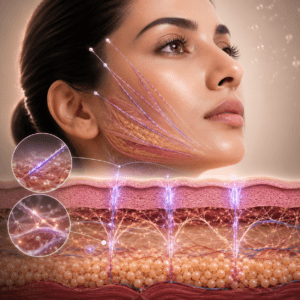
How Does Collagen Stimulation Help Sagging Skin?
Collagen contributes to the structure and mechanical properties of skin.
As part of the local healing and remodelling response following thread placement, collagen can develop around the thread track.
Research examining PCL threads found increased neocollagenesis and collagen-related markers after implantation, while studies involving PDO threads have also documented collagen changes around treated tissue.
In practical terms, this means Thread Lift may affect the treated area through two different timelines.
Mechanical support can be seen relatively early.
Biological tissue remodelling occurs more gradually.
This distinction is important.
The initial lifting effect does not come because the patient suddenly produced large amounts of new collagen within minutes.
The initial effect comes primarily from physical repositioning.
Collagen-related remodelling develops later.
How Is Thread Lift Used on the Cheeks?
When the cheeks begin to descend, the mid-face can appear flatter or heavier.
Threads may be positioned along planned lifting directions to engage the descended cheek tissue and provide a subtle upward and outward repositioning effect.
The aim is generally not to change the patient’s facial identity or pull the cheek unnaturally high.
Instead, the objective is to restore a more supported contour.
The exact direction of thread placement matters because facial lifting depends on vectors—the direction in which the tissue needs to move.
Recent technical literature emphasises that appropriately planned thread vectors influence the final facial contour.
How Does Thread Lift Improve the Jawline?
A jawline can begin appearing less defined when soft tissue starts descending toward the lower face.
In selected patients, Thread Lift may help by repositioning some of this tissue away from the jawline, producing a cleaner lower-face contour.
The treatment does not reshape the jawbone.
It also does not remove significant amounts of fat.
Instead, its lifting effect comes from changing the position and support of selected soft tissues.
This is why the result should usually be thought of as improved definition rather than the creation of an entirely new facial structure.
How Does Thread Lift Affect Jowls?
Jowls develop when tissue begins accumulating or descending around the lower border of the face.
Barbed lifting threads may be strategically positioned so that this descended tissue receives additional support.
When the tissue is elevated in an appropriate direction, the appearance of early jowling may become less prominent.
The principle is:
Engage → support → reposition.
However, if someone has very heavy jowls or significant loose skin, the amount that a thread can realistically reposition becomes limited.
Thread Lift therefore works differently in early jowling compared with advanced lower-face laxity.
How Is Thread Lift Used Around the Eyebrow Area?
Threads can also be used in selected upper-face treatment plans.
When the outer brow has descended slightly, carefully planned threads may create a subtle elevation.
The word subtle is particularly important around the eyebrows.
Small changes in eyebrow position can significantly change the expression of the face.
The objective should generally be mild repositioning—not creating an exaggerated pulled appearance.
How Does Thread Lift Affect the Neck?
The neck can develop mild tissue and skin laxity as part of ageing.
In selected cases, threads may provide support to mildly descended tissue and improve the appearance of the neck contour.
But neck ageing can also involve:
- Excess skin
- Fat accumulation
- Muscle banding
- Significant structural laxity
Threads do not treat all of these problems equally.
They mainly contribute through mechanical tissue support and local remodelling, so treatment needs to match the actual cause of the neck concern.
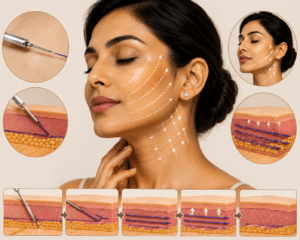
How Is the Thread Actually Used Beneath the Skin?
Thread Lift is not simply about inserting a thread and pulling it.
Before placement, the practitioner generally needs to determine:
- Which tissue needs to be repositioned
- Which direction it needs to move
- Which entry point is appropriate
- Which tissue plane should be used
- How much tension is required
- How the final contour should remain balanced on both sides
Facial anatomy is therefore central to the procedure.
Different areas of the face contain nerves, blood vessels, glands, ligaments and different tissue layers.
This is why correct depth and direction matter.
Thread Lift should be considered an anatomy-dependent medical aesthetic procedure rather than a simple cosmetic threading service.
How Does the Skin Respond Immediately After Treatment?
Because threads are placed beneath the skin, some temporary changes can occur following treatment.
These may include:
- Swelling
- Bruising
- Tenderness
- A feeling of tightness
- Mild temporary dimpling
- Sensitivity around the treated area
These effects usually relate to tissue manipulation and the normal response to thread placement.
Thread lifting also has recognised potential complications, including persistent dimpling, visible or palpable threads, infection, contour irregularity and thread extrusion, which is why technique and appropriate clinical management matter.
How Does Thread Lift Continue Working as the Thread Absorbs?
Absorbable threads are not designed to remain permanently in the face.
Materials such as PDO and PCL gradually break down over time.
Research on thread materials shows that different polymers have different degradation profiles and biological responses. PDO, for example, is progressively hydrolysed, while other materials such as PCL generally persist for different periods.
As the thread gradually absorbs, the body does not necessarily return instantly to the exact condition present before treatment.
Tissue remodelling has occurred around the thread pathway.
However, natural ageing continues.
This means Thread Lift should not be understood as permanently stopping facial sagging.
It provides temporary mechanical support combined with a biological tissue response, while the normal ageing process continues.
How Is Thread Lift Different From Simply Tightening the Skin?
This distinction is important.
Many patients use the words “tightening” and “lifting” interchangeably.
They are not exactly the same.
A skin-tightening treatment typically tries to improve firmness through thermal or biological remodelling.
Thread Lift adds something different:
physical tissue repositioning.
That is why a patient may experience lifting even before longer-term collagen remodelling develops.
The thread is acting as a support structure within the tissue.
How Much Can Thread Lift Change Sagging?
The answer depends on the degree of sagging.
Thread Lift generally works best when the desired change is controlled and relatively modest.
It should not be expected to:
- Remove large amounts of excess skin
- Completely reverse advanced facial sagging
- Produce the same correction as facelift surgery
- Permanently stop facial ageing
Thread Lift studies generally involve patients seeking modest facial rejuvenation rather than major surgical correction.
A natural Thread Lift result should ideally make someone look more supported and refreshed, not obviously pulled.
How We Approach Thread Lift at Brilliance Cosmocare
At Brilliance Cosmocare, after more than 10 years of experience in aesthetic treatments, our approach begins by understanding exactly how the patient’s face is changing.
We look at questions such as:
- Where is the tissue descending?
- Which direction would produce a natural-looking lift?
- Is the problem actually sagging, or is volume loss also involved?
- How much correction can threads realistically provide?
The objective is not to place as many threads as possible.
It is to understand how the tissue needs to be supported and how the facial proportions should remain balanced after treatment.
Final Thoughts
So, how does Thread Lift Treatment affect sagging skin?
It works through two main mechanisms.
First, specially designed threads mechanically engage and reposition selected facial tissues.
This can help improve concerns such as mild cheek descent, early jowls, reduced jawline definition, selected brow descent and mild neck laxity.
Second, the presence of absorbable threads can stimulate a local tissue-remodelling response, including fibroblast activity and collagen formation around the thread pathway.
The important point is that these two effects should not be confused.
The early lifting effect is primarily mechanical.
The longer-term tissue response is biological.
At Brilliance Cosmocare, DN Nagar, Andheri West, Mumbai, our philosophy after more than 10 years in aesthetic care is that successful Thread Lift Treatment should not simply pull the skin tighter.
It should use an understanding of facial anatomy, tissue movement, lifting direction and realistic correction to create a more balanced result.
Because the purpose of Thread Lift is not to make the face look unnaturally stretched.
It is to provide strategic support to facial tissue that has started to descend while working with the patient’s existing facial structure.