
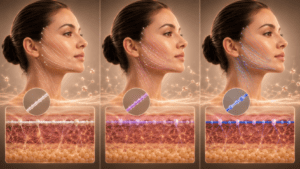
When patients start researching treatments for sagging skin, jowls or loss of facial definition, they usually come across several options: Thread Lift, HIFU, dermal fillers, skin-tightening treatments and surgical facelift procedures.
This can make choosing between them confusing.
At Brilliance Cosmocare, DN Nagar, Andheri West, Mumbai, one of the questions we frequently hear is:
“What exactly is a Thread Lift, and is it the best option for lifting my face?”
After more than 10 years of experience in aesthetic treatments, our approach is to first understand what a treatment can realistically do before calling it the “best.”
Thread Lift Treatment is a minimally invasive aesthetic procedure that uses specially designed threads placed beneath the skin to provide mechanical support and reposition selected facial tissues. Modern thread lifts commonly use absorbable, barbed or cogged sutures designed to engage tissue and create a lifting effect. The American Society of Plastic Surgeons describes thread lifting as a minimally invasive procedure using absorbable barbed sutures to create a tighter appearance of the face and neck.
But a Thread Lift is not the same as a surgical facelift, filler treatment or skin-tightening device.
Understanding those differences is the key to deciding whether Thread Lift is the right option.
What Exactly Is Thread Lift Treatment?
A Thread Lift is a non-surgical or minimally invasive facial lifting procedure in which medical threads are positioned beneath the skin.
Unlike traditional surgical facelift surgery, Thread Lift does not involve removing large amounts of excess skin or performing extensive surgical repositioning.
Instead, specially designed threads create support within selected facial tissues.
Modern facial thread lifting has evolved significantly from earlier techniques. Absorbable materials such as polydioxanone (PDO), poly-L-lactic acid (PLLA) and polycaprolactone (PCL) are now commonly discussed in the medical literature for facial thread lifting.
The important point is that “Thread Lift” is not one single identical product.
Different thread systems can have different:
- Materials
- Lengths
- Thicknesses
- Shapes
- Barbs or cogs
- Tensile properties
- Intended lifting characteristics
This means two procedures both advertised as Thread Lift Treatment may not necessarily involve the same type of thread or treatment design.
What Are Lifting Threads?
The word “thread” can make the treatment sound simpler than it actually is.
These are not ordinary cosmetic threads.
They are specially manufactured medical sutures designed for placement within facial tissue.
Many lifting threads contain barbs, cogs or other structural features that help engage the surrounding tissue. This allows the thread to provide mechanical support when positioned appropriately.
Modern absorbable threads gradually break down within the body rather than remaining permanently in the tissues. Different materials have different physical characteristics and degradation profiles.
The type of thread used can therefore influence the treatment strategy.
What Does a Thread Lift Actually Change?
Thread Lift Treatment primarily belongs to the category of facial tissue repositioning and minimally invasive facial rejuvenation.
This distinction is important.
Patients sometimes assume that every anti-ageing treatment does roughly the same thing.
It does not.
Thread Lift is primarily concerned with supporting and repositioning tissue that has started to descend.
It is not principally designed to:
- Remove pigmentation
- Treat acne scars
- Replace missing facial volume
- Remove large amounts of excess skin
- Produce the same degree of correction as facelift surgery
This is why the actual facial problem needs to be identified before selecting the treatment.

What Is the Difference Between Thread Lift and Dermal Fillers?
Thread Lift and dermal fillers are frequently compared because both are minimally invasive aesthetic treatments.
But they are fundamentally different.
- Dermal fillers primarily add or restore volume.
- Thread Lift primarily provides tissue support and repositioning.
Imagine a patient whose cheeks appear lower.
- In one patient, the dominant problem may be loss of facial volume.
- In another, the dominant problem may be tissue descent.
Adding more volume to tissue that primarily needs repositioning does not necessarily solve the correct problem.
Likewise, trying to lift an area where the dominant issue is volume loss may not provide the desired correction.
This is why Thread Lift and fillers should not automatically be treated as competing procedures.
In some aesthetic plans they may even address different aspects of facial ageing.
What Is the Difference Between Thread Lift and HIFU?
HIFU and Thread Lift are also commonly placed in the same “non-surgical lifting” category.
But again, they are not the same treatment.
HIFU is an energy-based treatment intended to stimulate tissue contraction and remodelling without physically placing lifting threads beneath the skin.
Thread Lift uses physical threads to support and reposition tissue.
Therefore, asking whether HIFU or threads are “better” without identifying the patient’s primary concern can be misleading.
- One is an energy-based treatment.
- The other is a minimally invasive tissue-suspension treatment.
- The treatment category itself is different.
What Is the Difference Between Thread Lift and a Surgical Facelift?
This is perhaps the most important comparison.
- A Thread Lift should not be presented as if it produces exactly the same correction as facelift surgery.
- A surgical facelift allows substantially greater mobilisation and repositioning of facial tissues and can address significant laxity and excess skin.
- A Thread Lift is much more limited in what it can physically correct.
Published reviews have raised concerns about overstating the long-term effectiveness of thread lifting and emphasise that evidence supporting it as an equivalent alternative to surgical rejuvenation remains limited.
Therefore, describing Thread Lift as a “facelift without surgery” can create unrealistic expectations if the patient interprets that phrase literally.
A more accurate description is:
- A minimally invasive facial lifting option capable of producing a more limited and subtle degree of tissue repositioning than surgical facelift surgery.
What Facial Areas Can Thread Lift Be Used For?
Thread Lift Treatment has been used across several facial and neck regions.
Published clinical studies have reported treatment involving areas such as the:
- Jawline
- Mid-face
- Eyebrow region
- Neck
In clinical aesthetic practice, the treatment concept may also be applied to concerns involving cheeks, lower-face tissue and early jowling.
However, Thread Lift should not be thought of as simply “putting threads everywhere.”
The facial area matters because different anatomical regions contain different tissue planes, vessels, nerves and retaining structures. Anatomical reviews emphasise that understanding these structures is important for safe and effective thread lifting.
What Is Thread Lift Not?
Understanding Thread Lift becomes easier when we define what it cannot reasonably be expected to do.
Thread Lift Is Not a Surgical Facelift
It cannot remove substantial amounts of excess skin or reproduce the degree of correction achievable with facial surgery.
Thread Lift Is Not a Filler
Threads do not primarily replace lost facial volume in the same way dermal fillers do.
Thread Lift Is Not a Skin-Resurfacing Treatment
It is not primarily intended to treat pigmentation, enlarged pores, acne scars or superficial skin texture.
Thread Lift Is Not Permanent
Modern absorbable lifting threads are designed to degrade over time. Published research confirms that absorbable thread materials gradually undergo biodegradation after placement.
Thread Lift Is Not Risk-Free
Although it is minimally invasive, potential complications include swelling, bruising, dimpling, visible or palpable threads, infection, thread extrusion and contour irregularities.
“Non-surgical” should therefore never be interpreted as “zero risk.”

Is Thread Lift the Best Option for Facial Lifting?
There is no responsible answer that says:
“Thread Lift is the best facial lifting treatment for everyone.”
The answer depends on what actually needs correction.
- If the main issue is significant excess skin and advanced tissue laxity, surgery may provide a degree of correction that threads cannot realistically reproduce.
- If the main problem is facial volume loss, filler or another volumising approach may be more relevant.
- If the objective is improvement in skin firmness without physically repositioning tissue, an energy-based treatment may be considered.
- If the dominant concern is modest tissue descent and the desired correction is relatively subtle, Thread Lift may be one option worth discussing.
This is why the word “best” should always come after diagnosis and assessment.
Is Thread Lift Better Because It Is Non-Surgical?
Not automatically.
Patients often associate “non-surgical” with:
safer, easier and better.
Those are three different claims.
A minimally invasive procedure generally avoids the extent of surgery involved in a traditional facelift, but it also provides a more limited correction.
There is a trade-off.
Less invasive treatment may mean a different recovery profile, but it can also mean less dramatic lifting.
Published literature on thread lifting shows encouraging outcomes in selected studies, including high levels of patient satisfaction, but other systematic reviews have highlighted limitations in the quality and consistency of long-term evidence.
That is why we prefer not to market Thread Lift as automatically superior simply because it does not involve major surgery.
What About PDO Thread Lift?
Patients frequently use the terms PDO Thread Lift and Thread Lift as though they mean exactly the same thing.
PDO stands for polydioxanone, one of the absorbable materials used to manufacture aesthetic lifting threads.
PDO is common, but it is not the only thread material available.
Modern thread-lifting literature also discusses PLLA and PCL-based threads, among other designs.
Therefore:
All PDO Thread Lifts are thread treatments, but not every modern Thread Lift necessarily uses PDO.
The material should be selected based on the actual treatment system and clinical plan rather than simply because “PDO” is the term a patient has seen most often online.
What Makes a Good Thread Lift Result?
Thread lifting should generally aim for proportionate improvement rather than obvious pulling.
A face should still look like the same face.
The objective is not to pull every tissue as tightly as possible.
Overcorrection, inappropriate vectors or incorrect placement can create unnatural contour changes or other problems. Published complication analyses have reported dimpling, contour irregularities, visible threads and extrusion among recognised issues following facial thread lifting.
This is why Thread Lift is much more than purchasing a particular number of threads.
The thread is simply a medical tool.
What matters is how appropriately that tool is used.
What Should “Best Option” Actually Mean?
At Brilliance Cosmocare, after more than 10 years of experience in aesthetic treatments, we believe the phrase “best treatment” is often used too casually.
The best option should not automatically mean:
- The newest treatment.
- The most expensive treatment.
- The least invasive treatment.
- The treatment trending on social media.
Or even:
The treatment the patient initially asks for.
The most appropriate option is the one that matches the actual facial concern and the degree of correction realistically required.
Sometimes that may be Thread Lift.
Sometimes another minimally invasive treatment may make more sense.
And sometimes the amount of laxity may be beyond what threads should reasonably be expected to correct.
Final Thoughts
So, what is Thread Lift Treatment?
Thread Lift is a minimally invasive facial rejuvenation procedure that uses specially designed medical threads often absorbable and barbed or cogged—to support and reposition selected facial tissues.
- It occupies a space between completely non-invasive skin treatments and surgical lifting procedures.
- It is not filler.
- It is not HIFU.
And it is not the same as a surgical facelift.
Each of those treatment categories addresses facial ageing differently.
At Brilliance Cosmocare, DN Nagar, Andheri West, Mumbai, our perspective after more than 10 years in aesthetic care is straightforward:
Thread Lift can be a valuable facial-lifting option, but calling it the “best” treatment without first understanding the facial problem creates the wrong expectation.
The better question is not simply: “Is Thread Lift the best?”
It is: “What exactly needs to be corrected, and which treatment category is most appropriate for achieving that correction?”
Understanding what Thread Lift is and equally importantly, what it is not—is the first step toward making that decision.