
When patients visit Brilliance Cosmocare, DN Nagar, Andheri West, Mumbai, many of them already know the name Glutathione IV Drip. What they often do not understand is how the treatment is supposed to influence the skin.
Common questions include:
- How does Glutathione IV benefit the skin?
- How is it used for skin concerns?
- How can something given through a vein affect skin pigmentation?
- Does it directly remove dark patches?
After more than 10 years of experience in aesthetic care, we believe these questions deserve realistic answers rather than promises of instant whitening.
Glutathione is naturally involved in the body’s antioxidant systems and has biological relationships with melanin production. However, the scientific evidence specifically supporting intravenous glutathione for cosmetic skin lightening remains limited, so its possible benefits should be discussed with appropriate expectations.
How Does Glutathione IV Enter the Body?
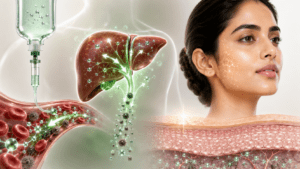
The first thing to understand is the word “IV.”
IV means intravenous, or within a vein.
During intravenous administration, a preparation is introduced through venous access so that it enters the bloodstream directly rather than first passing through the digestive system, as an oral supplement would.
This means Glutathione IV is a systemic treatment.
It does not sit on the surface of the skin like a cream or serum.
Once administered intravenously, the preparation enters the circulation rather than being applied specifically to one pigmentation spot.
This distinction explains both the attraction and the limitation of IV treatment.
It can reach the body systemically, but it also means that it cannot selectively target only one dark acne mark, one underarm, one patch of melasma or one dark elbow.
How Can Glutathione Potentially Affect Skin Pigmentation?
To understand the proposed skin effect, we first need to understand melanin.
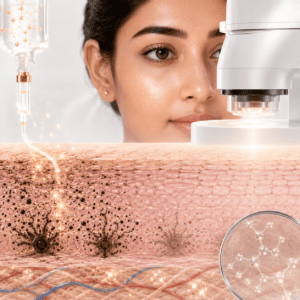
Melanin is the pigment responsible for much of the colour in our skin. It is produced by specialised cells called melanocytes through a biological process known as melanogenesis. Two major forms of melanin are eumelanin, which is darker, and pheomelanin, which is lighter in colour.
Laboratory research has shown that glutathione is involved in pathways related to melanogenesis and the balance of different melanin pigments. Experimental studies suggest glutathione can interact with processes occurring during melanin synthesis.
This biological relationship is one reason glutathione became popular in skin-brightening treatments.
However, there is an important distinction:
A biological mechanism does not automatically guarantee a visible clinical result.
Something may influence pigmentation pathways in laboratory research without producing dramatic or predictable skin-lightening effects in every patient.
That is why we separate the proposed mechanism from the actual clinical evidence.
How Is Glutathione Beneficial as an Antioxidant?
Glutathione is naturally present within human cells and is involved in antioxidant defence.
Antioxidants help manage reactive molecules generated during normal cellular metabolism and environmental stress.
The skin itself is continuously exposed to factors such as UV radiation, pollution and inflammatory processes.
This antioxidant role is one of the biological reasons glutathione has attracted attention in skin and wellness treatments.
However, patients should be careful with exaggerated phrases such as:
“Glutathione completely detoxifies your skin.”
That is a marketing simplification.
It is more scientifically accurate to say that glutathione participates in the body’s cellular antioxidant and redox systems.

How Could Glutathione Influence the Appearance of Uneven Skin Tone?
Uneven skin tone can occur when melanin production and distribution differ across areas of the skin.
Sun exposure, inflammation, acne, melasma and other factors can all influence pigmentation.
Because glutathione has been studied in relation to melanogenesis, researchers have investigated whether increasing glutathione availability can produce measurable changes in skin colour.
Clinical studies involving glutathione through different routes have produced mixed findings. A systematic assessment of the evidence concluded that there may be a trend toward skin brightening in exposed areas, but overall evidence remained inconclusive because of inconsistent findings and study quality.
For patients, this means any change should be viewed as variable rather than guaranteed.
We would not responsibly tell every patient:
“Your entire skin tone will become lighter.”
That cannot be predicted reliably.
How Is Glutathione IV Used in Aesthetic Practice?
In aesthetic settings, Glutathione IV is generally discussed with patients interested in concerns such as:
- Overall uneven-looking skin tone
- Dull-looking skin
- General skin-brightening goals
- Pigmentation concerns
- Differences between exposed and relatively protected skin areas
But at Brilliance Cosmocare, simply having pigmentation does not automatically mean that IV treatment should be selected.
The treatment first needs to fit the patient’s overall concern.
For example, someone with generalised uneven-looking skin presents a very different treatment problem from someone with three isolated acne marks on one cheek.
Because IV treatment is systemic, highly localised pigmentation may be better addressed using targeted skin treatments depending on the diagnosis.
How Does Glutathione IV Affect Dark Spots?
This is where expectations frequently become unrealistic.
A patient may point to one dark mark and ask:
“Will the IV remove this?”
Glutathione IV does not work like a laser beam or spot-treatment cream.
It cannot be directed specifically toward one pigmentation mark.
Therefore, post-acne hyperpigmentation, localised melasma, dark underarms or isolated body pigmentation may still require a targeted treatment strategy.
The fact that glutathione enters the bloodstream does not mean it automatically finds and removes areas containing excess pigmentation.
How Does Glutathione IV Affect Melasma?
Melasma deserves particular caution.
Patients with melasma sometimes assume that because glutathione has been associated with pigmentation pathways, IV glutathione must therefore be an effective melasma treatment.
That conclusion goes beyond the current evidence.
A 2025 review examining glutathione for skin lightening and melasma identified only one placebo-controlled study of intravenous glutathione and advised against recommending IV glutathione for skin lightening because evidence of efficacy remains limited and there are safety concerns.
This means Glutathione IV should not be presented as a standalone cure for melasma.
Melasma usually requires its own structured treatment strategy and management of contributing triggers.
How Does Glutathione IV Affect Natural Skin Colour?
This is another important distinction.
Every person has a naturally determined skin tone influenced significantly by genetics and melanin biology.
Glutathione IV should not be presented as a way to permanently replace someone’s natural skin colour with an entirely different one.
At Brilliance Cosmocare, our objective is not to tell people that naturally darker skin requires correction.
When discussing aesthetic treatment, the more appropriate goals are usually concerns such as:
uneven pigmentation, acquired tanning, dull-looking skin or specific pigmentary changes.
This creates healthier and more realistic expectations than promising a fixed number of “fairness shades.”
How Quickly Does Glutathione IV Affect the Skin?
Another misconception is that an IV infusion should produce immediate dramatic cosmetic change because the substance enters the bloodstream directly.
Direct intravenous delivery does not mean instant pigmentation removal.
Pigmentation involves biological processes occurring within the skin, and visible skin appearance is influenced by multiple ongoing factors.
Available clinical research does not establish a universal timeline in which every patient receiving IV glutathione will see a predictable cosmetic change. Research on glutathione and skin colour remains inconsistent overall.
This is why progress should not be judged by claims such as:
“One drip = instant glowing fair skin.”
Those statements are not supported by strong evidence.
How Should Skin Changes Be Evaluated?
One challenge with skin-brightening treatments is that perception can be unreliable.
Lighting, photography, makeup, sun exposure and even camera settings can make skin appear lighter or darker.
When patients are undergoing any pigmentation-related programme, progress is better assessed consistently.
That may include:
- Standardised photographs
- Similar lighting conditions
- Reviewing specific pigmentation areas
- Assessing the overall treatment plan
- Monitoring sun exposure and skincare
- Comparing realistic changes rather than chasing a fixed shade number
At Brilliance Cosmocare, we believe this approach gives patients a more honest understanding of whether their skin is actually changing.
How Can Sun Exposure Affect the Outcome?
No discussion of skin pigmentation is complete without sunlight.
Because pigmentation is influenced by environmental exposure, continuing significant UV exposure can work against a pigmentation-management programme.
This means Glutathione IV should never be viewed as a substitute for appropriate sun protection.
Someone receiving aesthetic treatment while ignoring regular UV exposure may continue developing tanning or worsening pigmentation regardless of how many additional treatments they undergo.
For pigmentation concerns, treatment and prevention need to work together.
How Safe Is the IV Route?
The intravenous route requires appropriate attention because the preparation is being delivered directly into the bloodstream.
Product sourcing, sterile preparation, IV technique and clinical monitoring therefore matter.
The U.S. FDA has previously reported adverse reactions after patients received compounded injectable glutathione prepared from an ingredient suspected of containing excessive bacterial endotoxins. Symptoms included nausea, vomiting, chills and lightheadedness, while one affected patient required hospital transfer after developing low blood pressure and breathing difficulty.
This does not mean every Glutathione IV produces such complications.
It does demonstrate why an intravenous aesthetic treatment should not be treated as casually as applying a skincare serum.
How Does Glutathione IV Fit Into a Complete Skin Treatment Plan?
Perhaps the most important thing we explain to patients is that one IV drip should not be expected to solve every skin concern.
Someone may have:
- Melasma
- Post-acne pigmentation
- Sun-induced tanning
- Dark underarms
- Uneven skin tone
- Active acne
- Inappropriate skincare
- Inconsistent sunscreen use
These problems may require different interventions.
Glutathione IV, when being considered, should therefore sit within a larger personalised skin strategy rather than replacing diagnosis, skincare, photoprotection or targeted professional treatments.
How We Approach Glutathione IV at Brilliance Cosmocare
After more than 10 years of experience in aesthetic care, we believe the most important part of treatment is matching expectations to biological reality.
We do not want a patient believing:
“The IV will travel directly to every dark patch and erase it.”
Instead, we explain that Glutathione IV is systemic, that glutathione has biological relationships with antioxidant systems and melanogenesis, and that clinical evidence for intravenous use specifically for cosmetic skin lightening remains limited.
That allows patients to make a more informed decision.
Final Thoughts
So, how does Glutathione IV Drip affect the skin?
Glutathione enters the circulation through intravenous administration and is biologically involved in antioxidant defence and pathways related to melanin formation. Laboratory research provides a biological rationale for its relationship with pigmentation.
But that does not mean every IV session will produce dramatic skin lightening.
The available clinical evidence specifically for intravenous glutathione remains limited, and cosmetic response cannot be guaranteed.
At Brilliance Cosmocare, DN Nagar, Andheri West, Mumbai, our approach is therefore based on three questions:
How is your skin actually changing?
How much of the concern is generalised versus localised pigmentation?
And how should Glutathione IV, if appropriate, fit within the rest of your skin-treatment plan?
Glutathione IV should not be seen as a magic fairness drip.
It should be understood as a systemic intravenous treatment with a plausible biological relationship to antioxidant activity and pigmentation—but with limitations that patients deserve to understand before treatment.
Because responsible aesthetic care is not about promising the biggest transformation.
It is about understanding how the treatment works, what it can realistically influence and where another treatment may make more sense.