
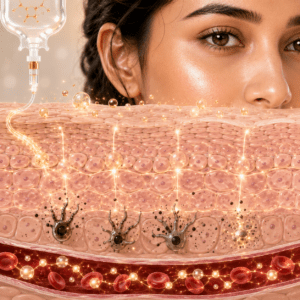
Glutathione IV Drip has become one of the most discussed treatments among patients looking for options related to skin brightness, uneven-looking skin tone and pigmentation concerns.
At Brilliance Cosmocare, DN Nagar, Andheri West, Mumbai, we regularly meet patients who have seen Glutathione IV treatments on social media, heard about them from friends or come across clinics promoting them as a premium skin-brightening treatment.
The most common question is:
“What exactly is Glutathione IV Drip, and is it the best option for my skin?”
With more than 10 years of experience in aesthetic treatments, our approach is to separate marketing from medical reality.
Glutathione is a genuine substance naturally present in the human body. However, that does not automatically mean that intravenous glutathione is the best cosmetic treatment for every pigmentation or skin-brightening concern.
Understanding exactly what the treatment is—and what it is not—is essential before considering it.
What Is Glutathione?
Glutathione is a naturally occurring tripeptide, meaning it is made from three amino acids: glutamate, cysteine and glycine.
It is present within cells throughout the body and plays an important role in antioxidant defence and cellular processes.
This antioxidant role is one of the main reasons glutathione has attracted interest in wellness and aesthetic medicine.
Researchers have also studied glutathione’s relationship with melanin production, which is why it has become widely marketed in different forms for skin-lightening and pigmentation-related purposes. Current research, however, shows that the evidence differs significantly depending on whether glutathione is used orally, topically or intravenously.
So, Glutathione IV Drip should not be thought of as simply a “fairness injection.”
It is more accurately described as an intravenous administration of a glutathione-containing preparation.
What Does “IV Drip” Mean?
IV stands for intravenous, which means “within a vein.”
An intravenous treatment delivers fluid or medication through a needle or cannula placed into a vein, allowing the preparation to enter the bloodstream directly.
This makes Glutathione IV fundamentally different from a cream, serum or tablet.
A topical product is applied to a particular area of the skin.
An oral product passes through the digestive system.
An IV treatment enters the circulation directly.
This distinction is important because Glutathione IV is a systemic treatment, not a targeted spot treatment.
It does not selectively travel to one dark acne mark, one pigmented cheek, one underarm or one dark elbow.
What Is Actually in a Glutathione IV Drip?
The central ingredient is glutathione, but the exact formulation can vary depending on the product and treatment protocol being used.
This is one reason patients should not assume that every treatment advertised as “Glutathione IV Drip” is identical.
The concentration, formulation, source of the injectable product and other components used in an IV protocol may differ between providers.
From our perspective at Brilliance Cosmocare, this distinction matters because something being administered intravenously should be treated as a medical procedure rather than simply another beauty treatment.
Product quality, sterile handling and appropriate clinical supervision remain important considerations with any intravenous preparation.
The U.S. FDA has previously documented adverse events associated with compounded injectable glutathione containing potentially excessive bacterial endotoxins, demonstrating the importance of appropriate sterile injectable quality.
What Is Glutathione IV Commonly Marketed For?
In aesthetic settings, Glutathione IV is commonly promoted in relation to:
- Skin brightening
- Uneven-looking skin tone
- Generalised pigmentation concerns
- Dull-looking complexion
- Overall skin radiance
- Skin-lightening goals
However, there is an important difference between what a treatment is marketed for and what scientific evidence has firmly established.
This is particularly relevant with intravenous glutathione.
A 2025 review evaluating glutathione for skin lightening and melasma found that there was only one placebo-controlled study involving intravenous glutathione. The authors advised against recommending the IV route for skin lightening because of limited evidence and safety concerns.
Therefore, we do not believe Glutathione IV should be described as a scientifically guaranteed whitening treatment.

What Is Glutathione IV Not?
Understanding a treatment properly also means understanding its limitations.
Glutathione IV Is Not a Guaranteed Fairness Treatment
No responsible clinic should promise that every patient will become a specific number of shades lighter.
Natural skin colour is influenced strongly by genetics and melanin biology.
A patient’s normal skin colour is not a disease that requires correction.
Glutathione IV Is Not a Permanent Skin-Whitening Treatment
Current scientific literature does not establish permanent cosmetic skin-lightening results from intravenous glutathione.
Questions regarding long-term effects, maintenance and duration remain incompletely answered.
Glutathione IV Is Not a Spot Pigmentation Treatment
If someone has:
- One dark acne mark
- Localised melasma
- Dark underarms
- Dark knees
- Dark elbows
- Dark knuckles
an intravenous treatment cannot selectively treat only that particular location.
Those conditions may require a different or more targeted treatment strategy.
Glutathione IV Is Not a Replacement for Diagnosis
Pigmentation has many possible causes.
Calling every dark patch “pigmentation” and immediately recommending an IV drip overlooks an important part of aesthetic medicine: identifying the actual skin condition first.
What Is the Difference Between Glutathione IV, Oral Glutathione and Topical Glutathione?
This is another area where patients frequently become confused.
The word “glutathione” can refer to several very different treatment formats.
- Oral Glutathione
Oral glutathione is consumed as a supplement.
Several studies have evaluated oral formulations for skin-lightening effects. Research has reported variable outcomes, and the overall evidence remains mixed, although the evidence base is larger than that for IV glutathione.
- Topical Glutathione
Topical glutathione is applied directly to the skin through creams, serums or other formulations.
Unlike an IV, topical treatment can be incorporated into a local skincare strategy.
- Intravenous Glutathione
Glutathione IV is administered directly into the circulation.
It is therefore a systemic treatment and requires intravenous access.
Importantly, the fact that IV administration enters the bloodstream directly does not automatically prove that it produces better cosmetic skin results.
That assumption is commonly made in marketing but is not established by strong comparative evidence. Current reviews remain particularly cautious about the intravenous route for cosmetic skin lightening.
Is Glutathione IV the Best Option for Skin Brightening?
There is no medically responsible answer that says:
“Yes, Glutathione IV is the best skin-brightening treatment for everyone.”
The better answer is:
It depends entirely on what the patient is trying to treat.
Someone with melasma has a different problem from someone with post-acne pigmentation.
Someone with dark underarms has a different concern from someone with overall uneven-looking skin.
A patient concerned about tanning may require a different treatment strategy from someone with naturally darker skin.
Therefore, there is no single treatment that can honestly be called the best option for every pigmentation concern.

What May Be Better Than Glutathione IV for Localised Pigmentation?
When pigmentation is highly localised, a targeted approach may sometimes make more clinical sense.
Depending on the diagnosis, treatment planning may involve options such as:
- Prescription or professional topical pigmentation treatments
- Chemical peels
- Laser-based pigmentation treatments
- Laser toning in selected patients
- Appropriate skincare
- Sun protection
- Management of the underlying pigmentation trigger
This does not mean these options are automatically better than Glutathione IV either.
The point is that “best” depends on the condition being treated.
If a patient has dark marks specifically from acne, targeting those marks and controlling the acne may be more logical than treating the entire body systemically.
If the patient has melasma, a structured melasma-management programme may be more appropriate than relying on an IV drip alone.
Is Glutathione IV the Best Option Because It Works Through the Bloodstream?
Not necessarily.
This is an important misconception.
Patients sometimes assume:
“If it goes directly into my blood, it must work better.”
Intravenous administration certainly changes how a substance enters the body, but route of administration alone does not prove superior cosmetic effectiveness.
A treatment should be considered better only when good-quality clinical evidence shows that it provides a meaningful advantage for the condition being treated.
At present, the scientific evidence for intravenous glutathione specifically for cosmetic skin lightening remains limited.
That is why we prefer realistic conversations rather than describing IV therapy as automatically superior because it is intravenous.
What Should “Best Treatment” Actually Mean?
At Brilliance Cosmocare, we believe the word “best” should be used carefully.
- The best treatment is not necessarily:
- The most expensive treatment.
- The newest treatment.
- The treatment trending on Instagram.
- The treatment administered through an IV.
- The treatment that promises the fastest transformation.
- The best option is the treatment that most appropriately matches the patient’s skin condition, treatment objective, medical history and realistic expectations.
- Sometimes Glutathione IV may be something a patient wants to discuss.
- Sometimes a targeted pigmentation treatment may make considerably more sense.
- Sometimes the correct starting point is simply improving skincare and sun protection before considering additional procedures.
What Is Our Approach at Brilliance Cosmocare?
With more than 10 years of experience in aesthetic treatments, our approach is not to position Glutathione IV as a miracle skin-whitening solution.
When a patient asks us about the treatment, we first want to understand exactly what they mean when they say:
“I want brighter skin.”
- Are they concerned about pigmentation?
- Melasma?
- Acne marks?
- Tanning?
- Dark underarms?
- Uneven facial tone?
- Are they trying to change their natural skin colour?
Those are completely different objectives.
Only after understanding the concern can an appropriate treatment strategy be discussed.
Final Thoughts
So, what exactly is Glutathione IV Drip?
It is an intravenous treatment involving glutathione, a naturally occurring tripeptide involved in antioxidant processes in the human body. Glutathione has attracted significant interest because of its possible relationship with melanin production and skin pigmentation.
But Glutathione IV should not be confused with a guaranteed fairness treatment, permanent whitening procedure or universal solution for pigmentation.
And is it the best option?
Not automatically.
Current evidence specifically supporting intravenous glutathione for cosmetic skin lightening remains limited, and recent reviews have advised caution regarding its use for that purpose.
At Brilliance Cosmocare, DN Nagar, Andheri West, Mumbai, our perspective after more than 10 years in aesthetic care is straightforward:
The best treatment is not the treatment with the biggest promise. It is the treatment that correctly matches the patient’s actual skin concern.
Glutathione IV can be discussed as one option within aesthetic care, but it should be considered with appropriate medical assessment, realistic expectations and an understanding of the limitations of the available evidence.
Before asking: “Is Glutathione IV the best treatment?”
A better starting point is: “What exactly is my skin concern, and which treatment is best suited to that condition?”