

Skin pigmentation is one of the most common concerns we hear from patients at Brilliance Cosmocare, DN Nagar, Andheri West, Mumbai.
Some patients are concerned about an overall uneven-looking skin tone. Others notice pigmentation on specific areas such as the face, neck, underarms, elbows, knees or knuckles. Post-acne marks, sun exposure and recurrent facial pigmentation are also common reasons people start exploring treatments such as Glutathione IV Drip.
With more than 10 years of experience in aesthetic treatments, our approach at Brilliance Cosmocare is simple: pigmentation should never be treated with a one-size-fits-all solution.
The first question should not be:
“Can Glutathione IV make my skin lighter?”
The more important question is:
“Why is my skin becoming pigmented, and is Glutathione IV appropriate for my concern?”
Different pigmentation concerns can have different causes. This is why proper skin assessment and realistic expectations are important before considering any treatment.
Why Has Glutathione IV Become Popular for Skin Concerns?
Glutathione is naturally present in the body and plays an important role in antioxidant defence. It has also attracted interest because of its potential relationship with melanin production and skin pigmentation.
As a result, Glutathione IV Drips have become increasingly popular among people looking for treatments related to uneven skin tone, dull-looking skin and pigmentation concerns.
However, popularity should not be confused with guaranteed results.
The available scientific evidence for intravenous glutathione specifically for cosmetic skin lightening remains limited. Therefore, we do not believe patients should be promised dramatic whitening or permanent changes to their natural skin colour.
At Brilliance Cosmocare, our focus is on understanding the patient’s actual concern and discussing realistic treatment possibilities rather than selling a promise of becoming several shades fairer.
Why Is Understanding the Type of Pigmentation Important?
Not every dark patch on the skin develops for the same reason.
Pigmentation may be associated with:
- Sun exposure
- Acne or previous inflammation
- Melasma
- Friction
- Skin irritation
- Hormonal influences
- Certain underlying medical conditions
- Natural variation in skin tone
- Repeated trauma to particular body areas
Two patients may both say:
“My skin has become darker.”
But their conditions may be completely different.
One may have pigmentation left after acne, while another may have melasma. Someone else may have dark underarms associated with repeated friction, while another person may simply have naturally darker pigmentation around certain joints.
Therefore, the reason behind pigmentation matters before deciding where Glutathione IV—or any other aesthetic treatment fits into the treatment plan.

Who Usually Asks Us About Glutathione IV Drip?
At Brilliance Cosmocare, patients considering Glutathione IV commonly come to us with concerns such as:
- Uneven-looking skin tone
- Dull or tired-looking complexion
- Sun-related tanning
- Facial pigmentation
- Post-acne dark marks
- Melasma concerns
- Dark neck
- Dark underarms
- Pigmented elbows and knees
- Dark knuckles
- Differences in tone between exposed and covered areas of the body
Having one of these concerns does not automatically mean Glutathione IV is the right treatment.
It means the skin should first be evaluated so we can understand what is causing the pigmentation and whether systemic treatment has a meaningful role.
Why Do Patients With Uneven Facial Tone Consider Glutathione IV?
One of the most frequent concerns we hear is:
“My face looks dull and uneven even though I take care of my skin.”
Facial skin is constantly exposed to sunlight, environmental factors, skincare products and inflammation.
Over time, these factors can contribute to uneven pigmentation.
This is one reason some patients begin exploring Glutathione IV treatment.
However, an important point should be understood:
An IV treatment is systemic. It is not a spot treatment.
It does not selectively travel only to one cheek, one dark patch or one acne mark.
Therefore, if a patient’s concern is highly localised, targeted pigmentation treatments may sometimes make more sense than relying entirely on an IV drip.
Why Does Melasma Need Special Attention?
Melasma is one of the most challenging pigmentation concerns we see.
It commonly appears as brown or grey-brown patches, particularly across areas such as the cheeks, forehead and upper lip.
Patients with melasma frequently ask:
“Will Glutathione IV clear my melasma?”
This is where realistic expectations become extremely important.
Melasma is influenced by multiple factors and can recur even after improvement. It generally requires a structured pigmentation-management strategy rather than depending on one treatment.
Glutathione IV should therefore not be presented as a guaranteed cure for melasma.
At Brilliance Cosmocare, a patient presenting with melasma should first have the pigmentation evaluated before deciding which combination of skincare, sun protection or professional treatments may be appropriate.

Why Are Post-Acne Dark Marks Different?
Many patients successfully control their acne but are left with dark marks afterward.
These marks are commonly referred to as post-inflammatory hyperpigmentation.
A patient may have clear skin but still feel that the face looks uneven because of multiple brown marks where previous pimples were present.
These marks need to be distinguished from active acne and other pigmentation disorders.
If pigmentation is concentrated in specific areas, targeted treatment may often form an important part of the treatment strategy.
This is another reason we do not automatically recommend systemic IV therapy simply because the patient says they have pigmentation.
The treatment should be selected based on the actual condition.
Why Do Patients With a Dark Neck Need Proper Evaluation?
A darker-looking neck is another common concern.
Patients sometimes assume that the pigmentation is simply due to tanning or lack of skincare.
That is not always the case.
Darkening around the neck can have several possible causes, which is why it should be properly evaluated rather than immediately treated as a cosmetic problem.
From our clinic perspective, if the pigmentation is almost entirely concentrated around the neck, the first priority should be understanding why the neck is darker.
A whole-body IV treatment should not automatically become the first answer to a localised problem.
Why Do Patients Ask About Glutathione IV for Dark Underarms?
Underarm pigmentation is another common aesthetic concern, especially among women.
Several factors can contribute to darker underarms, including repeated friction, shaving, irritation from certain products and previous inflammation.
If the pigmentation is primarily confined to the underarms, treating the local cause may be more important than using a systemic treatment alone.
At Brilliance Cosmocare, this is why we differentiate between generalised uneven skin tone and localised pigmentation.
The treatment plan needs to reflect that difference.
Why Are Dark Elbows and Knees Different?
Elbows and knees naturally experience more friction, pressure and repeated movement than many other areas of the body.
The skin can also be thicker in these locations.
As a result, some people notice that their elbows and knees appear darker than the surrounding skin.
Patients frequently ask whether Glutathione IV will remove this pigmentation.
Again, we need to remember that intravenous treatment does not selectively target one body area.
For localised concerns involving elbows or knees, local skincare or professional pigmentation treatments may sometimes be more relevant.
The key is matching the treatment to the actual concern.
Why Do Dark Knuckles Need Attention?
Dark knuckles can be particularly frustrating because the pigmentation remains visible even when someone takes good care of their hands.
Like other localised pigmentation concerns, several different factors may contribute.
This is why we do not believe every patient with dark knuckles should immediately start Glutathione IV therapy.
The appearance needs to be evaluated first.
If there is an underlying reason for the pigmentation, simply attempting to brighten the skin without addressing that reason may provide disappointing results.

Why Does Sun Exposure Matter?
Sun exposure is one of the biggest factors affecting pigmentation.
People living in Mumbai experience significant UV exposure throughout the year.
Even when someone receives professional pigmentation treatment, continuing excessive unprotected sun exposure can make pigmentation more difficult to control.
This is why sun protection remains an important part of almost every pigmentation-management programme.
No IV treatment should be viewed as a substitute for proper photoprotection.
If the trigger continues every day, repeatedly adding treatments without controlling that trigger is unlikely to be the strongest long-term strategy.
Why We Do Not Treat Natural Skin Colour as a Problem
At Brilliance Cosmocare, we believe this distinction is especially important.
There is a major difference between:
Treating uneven pigmentation & trying to change someone’s natural skin colour.
Natural skin tone is determined by genetics and biology.
It is not a disease and does not require correction.
Our objective should not be to convince patients that darker skin is unhealthy or unattractive.
Instead, aesthetic treatment can focus on concerns such as:
- Uneven pigmentation
- Acquired dark patches
- Sun-related changes
- Post-inflammatory marks
- Dull or uneven appearance
This creates much more realistic expectations.
Why Medical Supervision Matters for Glutathione IV
Glutathione IV is not simply a skincare product applied to the face.
It is administered intravenously.
That makes appropriate patient selection, injectable-product quality, sterile handling, proper IV technique and clinical monitoring important.
Even treatments that are marketed as wellness or aesthetic IV drips should not be treated casually.
Patients should understand what is being administered and who is medically supervising the procedure.
At Brilliance Cosmocare, we believe these questions should be part of the consultation rather than something patients discover only after purchasing a treatment package.
Who May Not Be Suitable for Glutathione IV?
Not everyone who wants brighter-looking skin should automatically undergo Glutathione IV treatment.
Medical history, medications, allergies, previous reactions and other individual factors may influence suitability.
Similarly, some pigmentation concerns may be better managed through other approaches.
Sometimes the correct decision may be:
Glutathione IV is not the treatment you need.
We consider that responsible treatment planning.
The goal of consultation should be to recommend what is appropriate—not simply to convert every enquiry into an IV session.
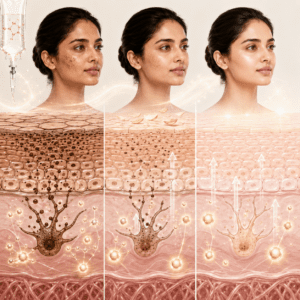
Why Glutathione IV Should Not Be Seen as a Standalone Solution
Skin pigmentation is often influenced by several factors simultaneously.
For example, a patient may have:
- Sun exposure
- Post-acne pigmentation
- Inconsistent sunscreen use
- An unsuitable skincare routine
- Melasma
- Localised friction-related pigmentation
Taking an IV drip while ignoring these factors is unlikely to represent a complete pigmentation-management strategy.
This is why Glutathione IV, when considered appropriate, should be viewed within the larger skin-treatment plan rather than as a single solution that replaces skincare, sun protection or targeted treatments.
Why Our Approach at Brilliance Cosmocare Is Different
With more than 10 years of experience in aesthetic treatments, we have seen that patients generally achieve better treatment experiences when expectations are established correctly from the beginning.
We do not want patients coming into the clinic believing that:
- “One IV drip will make me fair.”
Instead, we want to understand:
- What is bothering you about your skin?
- Is the pigmentation localised or generalised?
- Is it related to acne, melasma, sun exposure or another factor?
- Which areas are affected?
- Would a targeted treatment make more sense?
- Does Glutathione IV have a reasonable role in the overall plan?
These questions help create a more personalised approach.
Final Thoughts
Glutathione IV Drip has become popular among people seeking treatments for pigmentation and uneven-looking skin.
But from our perspective at Brilliance Cosmocare, DN Nagar, Andheri West, Mumbai, the most important thing is not how popular the treatment is.
It is understanding why the patient wants it.
- A patient concerned about melasma has a different problem from someone with post-acne pigmentation.
- A person with dark underarms requires a different assessment from someone concerned about overall uneven-looking skin.
Dark elbows, knees, knuckles and the neck can also have different causes.
This is why we do not believe in treating every pigmentation concern with the same approach.
After more than 10 years in aesthetic care, our philosophy remains simple:
Identify the pigmentation first. Understand why it is happening. Then choose the treatment.
Glutathione IV may be discussed as part of a treatment strategy in selected situations, but it should not replace proper diagnosis, realistic expectations or targeted pigmentation care.
Because successful skin treatment should not begin with the question: “How can I become fairer?”
It should begin with: “Why is my skin changing, and what is the most appropriate way to improve it?”