
When someone begins noticing increased hair fall or reduced density, the most important question is not simply whether a treatment is available. It is understanding how that treatment is expected to interact with the scalp and existing hair follicles.
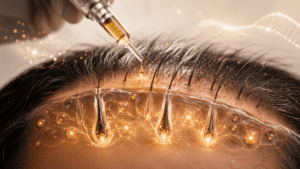
GFC Hair Regrowth Treatment is designed around concentrated platelet-derived growth factors. Instead of working only on the surface of the hair, these biological signalling proteins are delivered into selected areas of the scalp where viable follicles are present.
At Brilliance Cosmocare, Andheri West, Mumbai, with more than 10+ years of experience in hair and aesthetic treatments, we believe understanding how a treatment works is important before deciding whether it deserves a place in a patient’s hair-regrowth plan.
So, how is GFC beneficial? How is it used? And what exactly happens in the scalp after treatment?
How Is GFC Beneficial for Hair?
The potential benefit of GFC comes from the biological activity of platelet-derived growth factors.
Platelets contain several signalling molecules involved in tissue repair and cellular communication. GFC preparation is designed to concentrate these growth factors so they can be delivered directly into areas of hair thinning.
Growth factors discussed in the GFC literature include platelet-derived growth factor (PDGF), vascular endothelial growth factor (VEGF), epidermal growth factor (EGF) and insulin-like growth factor-1 (IGF-1). These molecules are associated with biological processes involving vascular support, cellular activity and the hair-follicle environment.
The idea is therefore not that GFC simply “feeds” the hair.
Its role is more accurately understood as providing biological signals to the environment surrounding existing follicles.
That distinction is important because hair growth is controlled by a complicated biological cycle. No single injection can force every follicle to grow regardless of its condition.
How Does GFC Support Existing Hair Follicles?
Hair follicles naturally move through different phases of growth, transition and rest.
In pattern hair loss, affected follicles can progressively miniaturise. The hair produced by these follicles can become finer, shorter and less visible over time.
GFC aims to support the biological environment around follicles that are still functioning.
Platelet-derived growth factors may influence pathways associated with follicular activity, tissue repair and vascular support. The clinical effect researchers are interested in is whether this can translate into measurable changes such as increased hair count or improved hair-shaft diameter.
A 2026 clinical and trichoscopic comparison involving patients with male and female pattern hair loss reported improvement in total hair count and shaft diameter following GFC treatment. Importantly, the study was relatively small, so these findings should be viewed as encouraging rather than proof that every patient will respond in the same way.
How Does GFC Affect the Scalp?
The scalp is more than the skin underneath the hair.
Each functioning follicle sits within a complex biological environment involving cells, connective tissue and blood vessels.
When GFC is introduced into the targeted scalp area, the concentrated growth factors can interact with this local environment.
Several processes may be relevant.
1. It May Support Blood-Vessel Activity Around Follicles
One growth factor commonly discussed is VEGF — Vascular Endothelial Growth Factor.
VEGF is associated with angiogenesis, the biological process through which blood-vessel development is regulated.
Blood supply is important to the follicular environment because actively growing follicles have metabolic requirements.
The scientific rationale behind platelet-derived regenerative treatment therefore includes supporting vascular activity around follicles rather than simply treating the visible hair shaft.
This does not mean GFC instantly creates a completely new vascular network or guarantees hair growth. It means vascular signalling is one of the mechanisms being investigated in regenerative hair treatment.
2. It May Influence Cellular Activity Around the Follicle
Growth factors such as PDGF and EGF participate in cellular signalling and tissue-remodelling processes.
PDGF has been associated with processes involving vascularisation and cells within connective tissue, while EGF participates in cellular proliferation and repair-related signalling. These biological activities form part of the rationale for concentrating platelet-derived factors and placing them near areas of follicular miniaturisation.
The scalp is therefore not being treated like a dry surface that simply needs moisture.
The treatment is attempting to interact with the biological environment in which the follicle operates.
3. It May Support the Hair-Growth Environment
IGF-1 is another growth factor associated with hair-follicle biology.
Growth-factor signalling is involved in maintaining communication between different cells around the follicle. GFC aims to deliver a concentrated combination of these signals rather than relying on a single isolated ingredient.
This is why the intended effect is gradual biological support rather than an immediate cosmetic change.

How Is GFC Used on the Scalp?
GFC is generally used as a targeted scalp treatment rather than something that is applied indiscriminately to every part of the head.
Before treatment, the areas of concern should first be identified.
For example, a patient may have greater thinning through the crown, frontal scalp or central parting.
The treatment area can then be planned according to the pattern of thinning and the presence of viable follicles.
The GFC material is prepared from the patient’s blood and subsequently delivered into selected areas of the scalp through multiple small injections.
The aim is to position the preparation close to the follicular environment rather than leaving it on the surface of the scalp.
A recent comparative clinical study used three treatment sessions spaced four weeks apart when evaluating GFC and PRP in pattern hair loss. However, this should not be interpreted as a universal prescription for every patient; protocols can differ depending on assessment and clinical circumstances.
How Does the Treatment Reach the Hair Follicles?
Hair follicles extend below the visible surface of the skin.
This is one reason simply applying a cosmetic product to the hair shaft is fundamentally different from an injectable regenerative treatment.
With GFC, the prepared growth-factor concentrate is placed into the targeted scalp tissue using small injections.
This local delivery allows the growth-factor preparation to be positioned near the areas where follicular biological activity occurs.
The treatment is therefore local rather than systemic: the objective is to treat selected scalp regions where support is required.
That does not mean every injected follicle automatically becomes thicker.
The follicle still needs to have sufficient biological capacity to respond.
How Can GFC Help With Hair Thickness?
One of the important measurements in hair-loss treatment is hair-shaft diameter.
Sometimes patients think only about the number of hairs on their scalp.
But the thickness of each hair also strongly affects how dense the scalp looks.
Imagine two people with a similar number of hairs. If one person’s individual shafts are significantly thinner, more scalp can remain visible.
This is one reason studies evaluate both hair count and shaft diameter.
In the 2026 PRP-versus-GFC comparison, GFC showed improvement in both parameters during follow-up, supporting the possibility that its benefit may involve not only hair numbers but also changes in the calibre of existing hair.
How Can GFC Reduce the Appearance of Thinning?
Visible density depends on several factors:
- Number of active hairs
- Thickness of individual hair shafts
- Distribution of the hairs
- Degree of follicular miniaturisation
- Area of scalp involved
If treatment supports some miniaturising follicles and improves measurable hair parameters, the scalp can gradually appear better covered.
This is very different from artificially filling a bald area.
GFC does not physically implant new follicles.
The clinical strategy is to work with the follicular population that already exists.
That is also why the condition of the scalp before treatment has such a major influence on what can realistically be achieved.

How Quickly Does GFC Affect the Scalp?
Biological activity begins long before a person can necessarily see a cosmetic difference in the mirror.
Hair follicles operate according to their own growth cycles, so visible hair changes cannot reasonably be expected immediately after the growth factors are delivered.
This is why clinical studies follow patients across multiple sessions and later assessments rather than judging the treatment a few days after injection. The available GFC studies have reported improvements over sequential assessments, but individual response varies.
In other words:
The injection happens in minutes; the biological response takes considerably longer.
How Should GFC Progress Be Monitored?
One problem in hair treatment is that memory is unreliable.
Patients see themselves every day, making gradual changes difficult to recognise objectively.
Monitoring can therefore include:
Standardised scalp photographs: Same lighting, angle and hairstyle whenever possible.
Trichoscopic assessment: Magnified examination can provide information about hair density and shaft characteristics.
Hair-count or density measurements: Useful when objective monitoring is available.
The 2026 comparative study itself used clinical photography and trichoscopic measurements rather than relying solely on patient perception.
This is a better way to determine whether treatment is actually producing measurable improvement.
How Does the Scalp Feel After GFC?
Because GFC involves injections, patients can experience temporary local effects related to the procedure.
Minor injection-site discomfort, sensitivity or temporary scalp reactions can occur with platelet-derived injectable treatments. Published GFC research has generally reported a favourable tolerability profile, but “autologous” should not be incorrectly translated into “zero risk.”
Sterile technique, appropriate patient selection and proper medical supervision therefore remain important.
How Does GFC Fit Into a Complete Hair-Regrowth Plan?
Perhaps the biggest mistake is assuming that one treatment must do everything.
GFC acts locally at the scalp and follicular environment.
But hair loss may also be influenced by genetics, hormones, nutrition, medical conditions and other factors.
That means a patient may sometimes require GFC as one component of a broader plan rather than as a standalone answer.
The treatment should therefore be used based on the patient’s diagnosis and scalp findings, not simply because GFC is currently a popular regenerative option.
How Should You Think About GFC?
The simplest way to understand the treatment is this:
GFC attempts to deliver concentrated platelet-derived biological signals directly into thinning areas of the scalp so that viable existing follicles have a more supportive regenerative environment.
The possible benefits include improvements in parameters such as hair count, hair-shaft diameter and overall appearance of density, but the magnitude of response differs between patients and the evidence base is still developing.
It cannot create unlimited new follicles.
It cannot guarantee regrowth.
And it cannot compensate for an incorrect diagnosis.
Final Thoughts
The real value of understanding how GFC works is that it creates realistic expectations.
GFC is not simply liquid injected into the scalp and it is not an instant hair-growth solution.
Its purpose is to place concentrated platelet-derived growth factors into targeted scalp areas, where those biological signals may support vascular activity, cellular communication and the environment surrounding viable hair follicles. Current clinical studies have shown encouraging improvements in measurable hair parameters, although larger studies are still needed to define its benefits more precisely.
At Brilliance Cosmocare, Andheri West, Mumbai, after more than 10+ years of experience in hair and aesthetic treatments, our approach is to look beyond simply administering a procedure.