
Hair Loss Is No Longer Just A Middle-Aged Problem
A decade ago, noticeable hair thinning and receding hairlines were concerns most people expected to face in their 40s or 50s.
Today, dermatology clinics across Mumbai are witnessing a very different trend.
Young professionals in their 20s and early 30s are increasingly seeking help for:
- Receding hairlines
- Excessive hair shedding
- Visible scalp
- Reduced hair density
- Premature thinning
Many of these individuals are otherwise healthy, active, ambitious, and successful in their careers.
So why are so many young professionals losing hair earlier than previous generations?
The answer lies in a combination of genetics, chronic stress, poor sleep, nutritional deficiencies, environmental exposure, and modern lifestyle habits that have become increasingly common in Mumbai’s fast-paced urban environment.
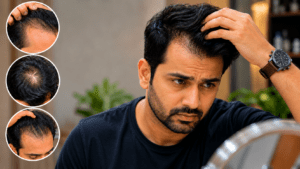
Is Early Hair Loss Really Becoming More Common?
What Dermatologists Are Observing
Hair loss consultations among younger adults have increased significantly over the past decade.
Dermatologists are now frequently seeing patients aged 22–35 years who present with:
- Early male pattern baldness
- Diffuse hair thinning
- Excessive daily shedding
- Widening hair partitions
- Reduced hair density
Part of this increase is due to greater awareness through social media and online education. However, earlier diagnosis also reveals that hair loss is genuinely affecting younger populations more frequently than before.
Why Appearance Matters More Than Ever
For today’s professionals, appearance is closely linked to confidence and self-image.
Video meetings, social media profiles, networking events, dating apps, and personal branding have made people far more aware of their appearance.
Many patients report noticing hair loss first during:
- Zoom meetings
- Selfies and photographs
- Instagram stories
- Professional presentations
As a result, concerns that may once have been ignored for years are now addressed much earlier.
The Mumbai Lifestyle: A Perfect Storm For Hair Loss
Mumbai offers incredible career opportunities, but its demanding lifestyle can create conditions that negatively affect hair health.
Chronic Workplace Stress
Long working hours, demanding deadlines, job competition, financial pressures, and performance expectations create persistent stress.
When stress levels remain elevated for prolonged periods, the body produces increased levels of cortisol and other stress hormones.
These hormonal changes can disrupt the normal hair growth cycle and push more follicles into the shedding phase.
Sleep Deprivation
Sleep is essential for cellular repair and hormonal regulation.
Many Mumbai professionals routinely:
- Sleep after midnight
- Work late into the evening
- Spend excessive time on screens
- Experience irregular sleep schedules
Poor sleep affects hormone balance, recovery mechanisms, and follicular health, making hair loss more likely.
Nutritional Shortcuts
Busy schedules often lead to unhealthy eating patterns.
Common habits include:
- Skipping breakfast
- Relying on food delivery apps
- Consuming highly processed meals
- Inadequate protein intake
Hair follicles are among the most metabolically active structures in the body and require adequate nutrition to function properly.
Common deficiencies associated with hair thinning include:
- Iron deficiency
- Low Vitamin D
- Vitamin B12 deficiency
- Zinc deficiency
- Inadequate protein intake
Sedentary Lifestyle
Long hours at desks reduce physical activity and may contribute to:
- Increased inflammation
- Metabolic imbalance
- Poor circulation
- Elevated stress levels
These factors indirectly influence scalp and follicular health over time.

Stress-Induced Hair Loss: The Hidden Epidemic
What Is Telogen Effluvium?
Telogen Effluvium is one of the most common causes of sudden hair shedding among young professionals.
Normally, hair follicles cycle through:
- Growth phase (Anagen)
- Transition phase (Catagen)
- Resting phase (Telogen)
Significant physical or emotional stress can prematurely push a large number of hairs into the telogen phase.
The result is noticeable shedding several weeks or months after the triggering event.
Common Triggers Among Professionals
Typical triggers include:
- Job changes
- Burnout
- Relationship stress
- Financial concerns
- Serious illness
- Post-COVID recovery
- Major life transitions
Warning Signs
You may be experiencing stress-related hair loss if you notice:
- Hair on your pillow every morning
- Excessive shedding while washing
- Increased hair on your comb
- Sudden reduction in hair volume
- Diffuse thinning across the scalp
Genetics Still Plays A Major Role
Understanding Male Pattern Baldness
Androgenetic Alopecia, commonly called Male Pattern Baldness, remains one of the leading causes of early hair loss.
This condition occurs because genetically sensitive hair follicles gradually shrink under the influence of DHT (Dihydrotestosterone).
Over time, follicles produce thinner and shorter hairs until growth becomes significantly reduced.
Why It Appears Earlier Today
Genetics often determine susceptibility.
However, modern lifestyle factors can accelerate progression.
Stress, poor sleep, nutritional deficiencies, and environmental exposure may worsen hair loss in individuals already genetically predisposed.
Early Signs Of Genetic Hair Loss
Common warning signs include:
- Receding hairline
- Thinning temples
- Increased forehead visibility
- Crown thinning
- Reduced hair shaft thickness
Early intervention typically provides better outcomes than waiting until significant hair density is lost.
How Pollution And Environmental Factors Affect Hair Health
Mumbai’s Urban Environment
Mumbai residents are exposed daily to:
- Traffic pollution
- Airborne particulate matter
- Dust
- UV radiation
- Industrial pollutants
These environmental stressors may contribute to scalp irritation and oxidative stress.
Effects On The Scalp
Environmental damage may result in:
- Inflammation
- Scalp sensitivity
- Increased oxidative stress
- Follicular dysfunction
- Weakened hair growth environment
Hard Water And Hair Quality
Hard water is another commonly overlooked factor.
Excess mineral deposits can contribute to:
- Hair dryness
- Increased breakage
- Rough texture
- Reduced manageability
Although hard water rarely causes permanent baldness, it can worsen overall hair quality.
Fitness Trends Can Sometimes Contribute To Hair Loss
While fitness is beneficial, extreme approaches may negatively affect hair health.
Crash Dieting
Rapid calorie restriction can deprive follicles of essential nutrients.
Aggressive Weight Loss
Sudden weight loss frequently triggers temporary shedding episodes.
Inadequate Protein Intake
Hair is primarily composed of keratin, a protein. Low protein diets may impair normal hair production.
Excessive Supplement Use
Unsupervised supplement use can sometimes contribute to hormonal imbalances and unexpected hair-related concerns.
Signs That Your Hair Loss Needs Professional Attention
You should consider professional evaluation if you notice:
Receding Hairline
The hairline gradually moves backward over time.
Visible Scalp
Scalp becomes noticeable under bright lighting.
Crown Thinning
Hair density reduces at the vertex area.
Hair Becoming Finer
Individual strands appear thinner and weaker.
Hair Fall Lasting More Than Three Months
Persistent shedding often warrants further investigation.
How Hair Loss Is Diagnosed
Accurate diagnosis is essential because different causes require different treatment strategies.
Medical History Assessment
Review of:
- Family history
- Medications
- Medical conditions
- Lifestyle factors
Lifestyle Analysis
Assessment of:
- Sleep habits
- Nutrition
- Stress levels
- Physical activity
Scalp Examination
Direct examination helps identify visible patterns of hair loss.
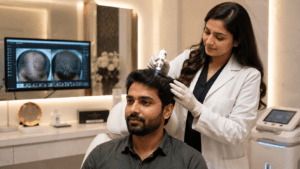
Trichoscopy
Advanced scalp imaging allows dermatologists to evaluate:
- Follicular density
- Miniaturization
- Hair shaft thickness
- Pattern distribution
Blood Tests
Investigations may include:
- Iron studies
- Ferritin
- Vitamin D
- Vitamin B12
- Thyroid profile
- Additional hormonal testing when indicated
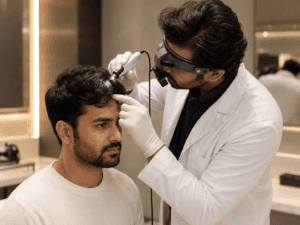
Treatment Options For Young Professionals Experiencing Hair Loss
The most appropriate treatment depends on the underlying cause, severity, and duration of hair loss.
Medical Hair Regrowth Programs
Suitable for:
- Early hair loss
- Mild thinning
- Preventive management
Benefits include:
- Slowing progression
- Supporting existing follicles
- Improving overall scalp health
GFC Hair Regrowth Treatment
Growth Factor Concentrate (GFC) therapy is commonly considered for:
- Early male pattern baldness
- Diffuse thinning
- Crown thinning
Potential benefits include:
- Growth factor stimulation
- Reduced shedding
- Improved density
- Enhanced follicular support
Exosome Hair Regrowth Therapy
Exosome-based therapies are increasingly used for:
- Moderate thinning
- Resistant hair loss
- Follicular rejuvenation support
Potential benefits include:
- Regenerative signaling
- Improved follicular activity
- Enhanced scalp environment
Lifestyle Optimization
Successful hair restoration often includes:
- Better sleep quality
- Improved nutrition
- Stress management
- Regular exercise
- Proper scalp care
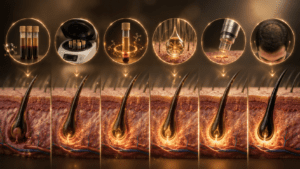
Can Early Hair Loss Be Prevented?
While not all forms of hair loss are preventable, several habits may help support long-term hair health.
Prioritize Sleep
Aim for 7–8 hours of quality sleep.
Improve Nutrition
Focus on protein-rich, nutrient-dense meals.
Manage Stress
Exercise, meditation, and work-life balance can help reduce chronic stress.
Exercise Regularly
Physical activity supports overall metabolic health.
Seek Early Diagnosis
The earlier hair loss is evaluated, the greater the opportunity to preserve existing hair.
Why Young Professionals In Andheri Choose Brilliance Clinic
Dermatologist-Led Hair Assessments
Every patient receives a detailed evaluation rather than a one-size-fits-all solution.
Advanced Trichoscopy Evaluation
High-resolution scalp analysis helps identify early changes before they become obvious.
Personalized Hair Regrowth Programs
Treatment plans are tailored according to:
- Diagnosis
- Hair loss pattern
- Lifestyle factors
- Treatment goals
Evidence-Based Treatment Approach
Focus on medically guided therapies supported by clinical assessment.
Convenient Location Near DN Nagar Metro
Located in DN Nagar, Andheri West, making consultations convenient for professionals across:
- Andheri
- Lokhandwala
- Versova
- Oshiwara
- Juhu
- Goregaon
Frequently Asked Questions
Why am I losing hair in my 20s?
Hair loss in your 20s can result from genetics, stress, nutritional deficiencies, poor sleep, hormonal changes, or medical conditions.
Can stress alone cause hair loss?
Yes. Significant stress can trigger Telogen Effluvium, leading to noticeable shedding.
Is hair loss reversible in young adults?
Many causes of hair loss can improve when diagnosed and treated early.
Does Mumbai pollution contribute to hair loss?
Pollution may contribute to scalp inflammation and oxidative stress, which can affect hair health.
How can I tell if my hair loss is genetic?
A receding hairline, thinning temples, and family history often suggest genetic hair loss.
Can nutritional deficiencies cause hair thinning?
Yes. Iron, Vitamin D, B12, zinc, and protein deficiencies are common contributors.
What is the best treatment for early-stage hair loss?
The best treatment depends on the cause and requires professional assessment.
How soon should I seek treatment?
If hair loss persists beyond three months or progressively worsens, seek evaluation promptly.
Is GFC suitable for young professionals?
Many young professionals with early-stage thinning may be candidates for GFC after proper assessment.
Can hair loss be prevented completely?
No. However, early diagnosis and healthy lifestyle habits can significantly reduce risk and slow progression.
Final Thoughts
Hair loss among young professionals in Mumbai is becoming increasingly common.
A combination of genetics, workplace stress, sleep deprivation, nutritional deficiencies, environmental exposure, and modern lifestyle habits is contributing to earlier onset hair thinning than previous generations experienced.
The encouraging news is that early intervention often offers the best opportunity to preserve hair density and support healthier long-term growth.
Understanding the root cause of hair loss is the first step toward finding the right solution.
Concerned About Early Hair Loss?
If you’ve noticed increased shedding, a receding hairline, or thinning hair, don’t wait until the problem becomes more advanced.
Book a professional hair assessment at Brilliance Clinic, DN Nagar, Andheri West.
Our team evaluates your scalp health, hair density, lifestyle factors, and underlying causes to create a personalized hair restoration plan tailored to your needs.
📍 DN Nagar, Andheri West, Mumbai
📞 +91 9867017350 | +91 7304373500 | +91 7506661196
💬 WhatsApp Consultation Available