

- If someone looks fit, we often assume they are healthy.
- If someone has glowing skin, we assume they take great care of themselves.
- If someone is slim, energetic, and well-groomed, we naturally think they must be in good health.
After all, health is supposed to be visible.
- Isn’t it?
Not always in fact, one of the most surprising lessons modern medicine has taught us is that looking healthy and being healthy are not necessarily the same thing.
- Many health conditions develop quietly.
- Many imbalances remain hidden.
And sometimes, the body can appear perfectly fine on the outside while struggling internally.
This is why doctors often say:
- “The absence of symptoms does not always mean the absence of disease.”
And perhaps the same is true for appearance looking healthy does not always mean the body is functioning optimally.
The Health Illusion
We live in a world where appearance often influences perception a lean person is assumed to be healthy an overweight person is often assumed to be unhealthy a person with clear skin is assumed to have perfect health someone with visible concerns may be judged differently.
But biology doesn’t always follow appearances many people who appear healthy may have:
- Vitamin deficiencies.
- Hormonal imbalances.
- Insulin resistance.
- Fatty liver disease.
- High cholesterol.
- Thyroid disorders.
- Chronic stress.
- Poor sleep quality.
And they may have no obvious outward signs.
Similarly, some people carrying extra weight may have surprisingly healthy metabolic profiles the body is far more complex than appearances suggest.
The “Skinny but Unhealthy” Phenomenon
One of the biggest misconceptions in health is that slim automatically means healthy doctors increasingly recognize a group of individuals who appear thin but may have underlying metabolic concerns some people maintain a normal body weight while still developing:
- High blood sugar.
- Insulin resistance.
- High cholesterol.
- Fat accumulation around internal organs.
- Poor cardiovascular fitness.
This is sometimes referred to as being “metabolically unhealthy despite normal weight.”
The scale only measures body weight it does not measure overall health.
The Hidden Fat Nobody Sees
Most people focus on visible fat.
- The fat around the stomach.
- The thighs.
- The arms.
But one of the most important types of fat is often invisible visceral fat this is the fat stored around internal organs a person may not appear significantly overweight yet they may still carry excess visceral fat this deeper fat is often associated with:
Type 2 diabetes.
- Cardiovascular disease.
- Fatty liver disease.
- Metabolic dysfunction.
This is one reason doctors evaluate more than appearance when assessing health.
Clear Skin Doesn’t Always Mean Internal Health

As dermatologists, we see this frequently.
Many people assume healthy-looking skin automatically reflects perfect health.
While skin can reveal important clues about the body, it does not tell the entire story.
Someone may have:
- Beautiful skin.
- Minimal acne.
- Even skin tone.
Yet still struggle with:
- Nutritional deficiencies.
- Hormonal imbalances.
- Chronic inflammation.
- Poor sleep.
- Stress-related health issues.
The skin is important.
But it is only one part of a much larger picture.
Energy Is Not Always Health
Some people seem endlessly energetic they work long hours exercise regularly sleep very little and appear to function perfectly but appearance can sometimes be misleading the body is remarkably adaptable people can continue performing well despite accumulating stress, poor sleep, and unhealthy habits eventually, however, the body often begins asking for payment the consequences may not appear immediately.
But they can emerge months or years later health is not simply about how we feel today it is also about how our body is functioning beneath the surface.
Stress Is Often Invisible
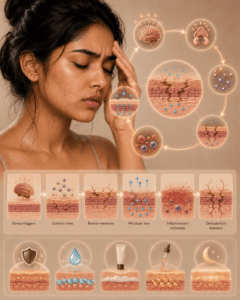
Stress is one of the best examples of the difference between appearance and reality.
A person may appear calm, successful, and healthy meanwhile, internally, stress hormones may remain elevated.
- Sleep quality may be poor.
- Inflammation may increase.
- Blood pressure may rise.
- Digestive issues may develop.
- Stress rarely announces itself dramatically.
Often, it quietly influences multiple systems throughout the body and many people learn about its effects only after symptoms begin appearing.
The Social Media Problem
Modern social media has created a distorted image of health.
- Perfect skin.
- Perfect bodies.
- Perfect lifestyles.
- Perfect routines.
The problem is that health cannot be accurately measured through photographs.
A photograph cannot reveal:
- Hormone levels.
- Mental health.
- Sleep quality.
- Stress levels.
- Nutritional status.
- Metabolic health.
Yet many people compare their reality to someone else’s carefully curated highlight reel.
Health is far deeper than appearance and no social media filter can accurately measure it.
What Real Health Actually Looks Like
Real health is often less dramatic than people expect.
It is not simply having visible abs or flawless skin or a certain number on the scale.
Real health involves:
- Physical well-being.
- Mental well-being.
- Hormonal balance.
- Good sleep.
- Healthy relationships.
- Emotional resilience.
- Adequate nutrition.
- Sustainable habits.
It is a collection of small daily choices rather than a single visible feature.
Why Prevention Matters
One reason preventive healthcare is so important is because many conditions remain silent during their early stages the body often compensates remarkably well people can feel normal while underlying issues continue developing this is why regular health evaluations matter not because everyone is sick but because waiting for symptoms is not always the best strategy many health conditions are easier to address when identified early.
The Emotional Side of Health
Perhaps the most important lesson is this:
Health should not be judged by appearance alone many people struggle because they compare themselves to others they assume someone who looks healthier must actually be healthier but appearances rarely tell the entire story.
- Every person has challenges that may not be visible.
- Every body has its own strengths and vulnerabilities.
True health is not a competition it is a personal journey.
A Final Thought
Looking healthy and being healthy often overlap but they are not identical appearance can provide clues it can offer insights.
But it cannot reveal everything happening inside the body the healthiest person in the room is not always the leanest.
- Not always the youngest.
- Not always the one with the clearest skin.
Real health is measured by how well the body functions , not simply how it looks and perhaps that is a comforting thought because health is not about achieving perfection it is about creating habits that support the body, mind, and overall well-being over time.
- The goal should never be to merely look healthy.
- The goal should be to truly be healthy.