
Have you ever met someone who seems to eat everything they want and never gain weight?
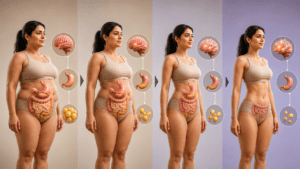
And then there are others who carefully choose salads, avoid junk food, drink plenty of water, and still struggle with the scale , For many people, this feels unfair :
- They put in the effort.
- They make healthier food choices.
- They try to stay disciplined.
Yet the weight doesn’t move , Or worse, it continues to increase ,Naturally, this leads to frustration , Many begin questioning themselves :
- “Am I doing something wrong?”
- “Is my metabolism broken?”
- “Why isn’t healthy eating working for me?”
The truth is that weight management is often far more complicated than simply eating foods that are considered healthy , some people gain weight despite making genuinely good food choices to understand why, we need to look beyond calories and explore what is happening inside the body.
Healthy Food Does Not Always Mean Weight Loss
One of the biggest misconceptions in nutrition is that healthy foods automatically lead to weight loss , healthy and weight-loss-friendly are not always the same thing.
Consider foods like:
- Nuts.
- Dry fruits.
- Nut butters.
- Granola.
- Smoothies.
- Protein bars.
- Cold-pressed juices.
- Avocados.
These foods can be nutritious , they contain vitamins, minerals, healthy fats, and antioxidants but they can also be surprisingly calorie-dense.
A person may be eating “healthy” while unknowingly consuming more energy than their body requires , the body doesn’t only respond to whether food is healthy , It also responds to how much energy is being consumed.
Portion Size Matters More Than Most People Realize

Many people carefully choose healthy foods but underestimate portion sizes.
- A handful of almonds becomes three handfuls.
- A smoothie becomes a meal-sized drink.
- A healthy snack turns into several snacks throughout the day.
These small additions often go unnoticed.
- The problem isn’t the food itself.
- The problem is quantity.
Even healthy foods can contribute to weight gain when consumed in excess , This doesn’t mean people should stop eating nutritious foods , It simply means that awareness matters.
The Hidden Calories Nobody Thinks About
Sometimes the issue isn’t the main meal , It’s everything around it.
- The extra spoon of peanut butter.
- The handful of trail mix.
- The healthy coffee drink.
- The fruit juice.
- The post-workout snack.
- The weekend indulgence.
Individually, these seem harmless.
Collectively, they can significantly increase daily calorie intake.
Many people who feel they are eating “very little” are surprised when they carefully track everything they consume.
The hidden calories often tell a different story.
Hormones Can Influence Weight

Weight gain is not always about willpower.
Hormones play a major role.
The body uses hormones to regulate:
- Appetite.
- Fat storage.
- Energy expenditure.
- Blood sugar control.
When hormonal imbalances occur, losing weight may become more challenging.
Conditions such as:
- Polycystic Ovary Syndrome (PCOS).
- Hypothyroidism.
- Insulin resistance.
- Menopause-related hormonal changes.
- Can all influence body weight.
This is one reason why two people eating similar diets may experience very different results.
Their biology is not identical.
The Insulin Resistance Problem
One of the most common reasons people struggle with weight despite eating relatively well is insulin resistance , Insulin is a hormone that helps move glucose from the bloodstream into cells , When the body becomes resistant to insulin, it often needs to produce more of it , Higher insulin levels can make fat loss more difficult.
Many individuals with insulin resistance experience:
- Weight gain around the abdomen.
- Sugar cravings.
- Fatigue after meals.
- Difficulty losing weight.
- Increased hunger.
The frustrating part is that many of these individuals feel they are trying hard and often, they are.
The challenge lies in how the body is processing energy.
Poor Sleep Can Sabotage Healthy Eating

Imagine sleeping only five or six hours every night , You may still eat healthy foods, But your body begins changing :
- Hunger hormones become disrupted.
- Cravings increase.
- Energy levels decline.
- Decision-making becomes harder.
Research consistently shows that inadequate sleep is associated with increased hunger and weight gain , in other words, healthy eating cannot fully compensate for chronic sleep deprivation , Your body needs rest to regulate metabolism effectively.
Stress Changes More Than Your Mood
Modern life is stressful:
- Work pressure.
- Family responsibilities.
- Financial concerns.
- Constant notifications.
The body responds to chronic stress by increasing cortisol levels , Cortisol is often called the stress hormone , When elevated for prolonged periods, it may influence appetite, cravings, and fat storage , Many people notice increased hunger during stressful periods Others find themselves eating emotionally rather than physically , This doesn’t mean stress directly causes obesity but it can certainly make weight management more difficult.
Exercise Isn’t Always the Solution
Many people increase exercise when they gain weight , While physical activity is extremely important for health, it doesn’t always produce immediate weight loss , Some individuals unknowingly compensate after workouts , They eat more move less during the rest of the day Or overestimate the calories burned during exercise.
The result is disappointment.
Exercise remains one of the best things you can do for long-term health but sustainable weight management usually requires attention to multiple factors, not just workouts.
Your Body May Be Defending Its Weight

The human body is incredibly intelligent when weight begins changing significantly, the body often responds appetite may increase.
- Energy expenditure may decrease.
- Hunger signals may become stronger.
This is one reason why maintaining weight loss can sometimes feel harder than losing it the body evolved to protect itself from perceived starvation , unfortunately, this protective mechanism can make modern weight management more challenging.
The Emotional Side of Weight Gain
Perhaps the most overlooked aspect of weight gain is how it affects people emotionally many individuals blame themselves they feel guilty :
- Ashamed.
- Frustrated.
They wonder why their efforts aren’t working , but weight is influenced by far more than motivation.
- Genetics.
- Hormones.
- Sleep.
- Stress.
- Metabolism.
- Lifestyle.
- Medical conditions.
All play a role ,this doesn’t mean healthy habits are unimportant , it means people deserve understanding rather than judgment.
A Final Thought
If you’re gaining weight despite eating healthy, it doesn’t automatically mean you’re failing it may mean that something important is being overlooked.
- Perhaps it’s portion sizes.
- Perhaps it’s sleep.
- Perhaps it’s stress.
- Perhaps it’s hormones.
Or perhaps it’s a combination of several factors working together.
The human body is complex , weight gain is rarely caused by a single reason and successful weight management rarely comes from a single solution.
The goal is not simply to eat healthy , the goal is to understand how your body responds to what you eat, how you live, and what is happening beneath the surface , because lasting weight loss begins not with blame.